

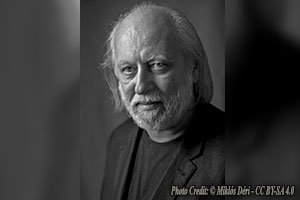
Imagine literary works with plots in dystopian settings where the characters act within an unraveling social order. Apocalyptic events abound inside absurd situations. This is the literature of Laszlo Krasznahorkai.
There is more. Imagine an unreadable and drawn-out style. Think of run-on texts that are like rivers of black ink that frantically flow everywhere, following no rules. Some have no paragraphs. One novel, for example, is four hundred pages long yet consists of a single sentence! This is the literature of Laszlo Krasznahorkai.

Imagine obsessive characters, rain-sodden landscapes and scenes of pathos and despair. Imagine dark narratives like those of Dostoevsky and Kafka, full of irony, satire and the celebration of the absurd. This is the literature of Laszlo Krasznahorkai.
This 71-year-old Hungarian “master of the apocalypse” just won the 2025 Nobel Prize for Literature.
Defeating the Purpose of Literature
Such a choice speaks much of the tragic state of literature in America and the world. The system is clearly broken.
The Nobel Prize for Literature is the world’s highest and most prestigious literary award. It should be given to writers who elevate people’s horizons. This author presents dark dystopias of social decay.
Why America Must Reject Isolationism and Its Dangers
Literature should aim to bring people closer to the good, true and beautiful. This author concentrates on the absurd, evil and ugly. Literature provides the ideal opportunity to draw moral lessons even amid the darkest tragedy and adversity. This writer recognizes no objective moral order.
Small Horizons and Class Struggle
Under the present broken system, the Nobel literature prize no longer goes to immortalized authors like those of times past, known to everyone and connected to reality. It now belongs to those who reject Western thought and rationality. The most recent awardees do not present universal perspectives but dwell upon subjective micro-narratives, rambling on aimlessly.
The prize has come to belong to those who weaponized literature to reflect class struggle, sexual themes, Freudian psychology and nihilistic ideologies.
Laszlo Krasznahorkai enters this literary wasteland, full of intense feelings and emotions.
A Nightmare in Print
Laszlo Krasznahorkai has been criticized for his “difficult” and “demanding” novels filled with melancholic themes.
Help Remove Jesus Bath Mat on Amazon
His often pages-long sentences are termed “challenging” to readers and do much to construct labyrinthine narratives that refuse to adhere to traditional plot conventions. He introduces confusing digressions inside his dense prose. Critic James Wood compared reading his works to “a journey toward an abyss.”
Reviewers claim that his character and plot development blur distinctions between reality and fantasy, rational and absurd. The Nobel Committee notes that his plots do not resolve but rather dissolve. Characters enter and leave without a clear purpose. The run-forever-on sentences maintain a pace that oscillates between wearisome rambling and dramatic action.
The overall effect is like that of a drug trip, where everything and nothing can be expected at the same time. It is apocalypse and monotony, absurdity and reality, being and nothingness all rolled into one deconstructed tale that overwhelms the reader’s imagination.
Turning Defects into Qualities
In normal times, this criticism would be enough to consign any such novels to oblivion. One purpose of literature is to provide clarity and insight; these works purposely muddle and disorient.
Satanic Christ Porn-blasphemy at Walmart — Sign Petition
However, praise for Laszlo Krasznahorkai’s work magically turns these narcotic defects into dazzling qualities. Critics favorable to his work claim that the dense prose with overlong sentences and erratic plot development has a hypnotic and mesmerizing effect that creates an “immersive reading experience.”
These defects create a powerful impact, a numbing uneasiness and mystifying complexity that reviewers claim make his work a “positive encounter” with unique ideas and raw emotions.
Lazslo Krasznahorkai is also praised for his apocalyptic themes and dark humor, which add to the madness of these encounters. His settings depict decaying reality, bleak futility and existential fears. His Kafkesque stories are cast with madmen, fools and charlatans, which makes them all the more bizarre and absurd.
Thus, for example, a recent NPR reviewer described the author’s Satantango novel as follows: “The story takes place at a nearly abandoned collective farm where life is so bleak and so depressing that people still there are all plotting to get away. The novel was written without any paragraphs. It’s just massive blocks of type.”
How Panera’s Socialist Bread Ruined Company
Such is the stuff of nightmares, not great literary works of art. Would that the literary establishment might admit that the emperor has no clothes!
The Ravages of Postmodernity
Thus, Laszlo Krasznahorkai should not receive the 2025 Nobel Prize for Literature. This is not a personal attack upon the Hungarian writer but a consideration about the postmodern nature of his works.
The postmodern perspective he utilizes wreaks havoc upon literature. By questioning all narratives, postmodern writers no longer need to construct rational, coherent stories. Indeed, they emphasize deconstructing stories, conventions, morals and even grammar. Such classical literary instruments are considered oppressive and restrictive, and thus writers are free to discard them.
Postmodern literature is a brutal tool for fragmenting, isolating and shattering the ideals of unity and harmony that literature once so well expressed with wonder and beauty.
What Does Saint Thomas Aquinas Say About Marriage?
It makes no sense to reward those who frustrate the purposes of literature with a major prize.
Finding Meaning in Literature
True literature attracts because of its excellence of expression. It communicates ideas of universal interest and enduring value. Postmodernity makes all things subjective, fluid and banal.
Literature should inspire, enlighten and uplift as it embarks upon its quest for truth and beauty. Even in tragedy and calamity, literature should teach and highlight the dignity of suffering and terrible splendor often found in adversity. Good literature should have a moral message. It should be a means of understanding God’s Creation better and encouraging the practice of virtue.
Such norms are contrary to the postmodern obsession for the bizarre, ugly and absurd, where plots have no purpose and conflict has no meaning.
Is It Immodest to Wear Deliberately Ripped Clothes?
If there is something the world does not need now, it is nihilistic tales of gloomy despair. Let there not be literature consisting of jumbled images, emotions and experiences that do not convey coherence and order but communicate disorder and wantonness. Above all, let not the world recognize these ramblings as things worthy of universal acclaim.
A Broken System
When the Nobel Prize in Literature is given to these postmodern writers, the award becomes part of a postmodern narrative by celebrating the absurd. It applauds unknown writers who deliver confused messages and construct nihilistic plots, which are embraced by critics who claim to find value in their convoluted works.
Literature should return to its noble purposes. It should regenerate, not degenerate, inspire, not conspire against, a moral order. Alas, literature should lead to an appreciation of excellence and beauty that ultimately brings people closer to God.
Photo Credit: © Miklós Déri – CC BY-SA 4.0
