


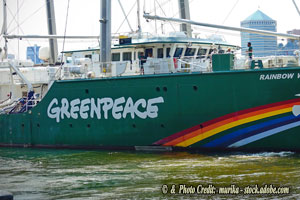
An international legal struggle may be starting that could test the U.S. government’s determination to resist European attempts to dictate legal jurisdiction and procedure.
In March 2025, the environmental activist group, Greenpeace USA, was found liable and ordered by a North Dakota court to pay over $660 million to the Texas-based corporation, Energy Transfer. Later, the trial judge reduced the award to $345 million. Even though the revised amount cut the amount almost in half, that is still a tremendous amount for an organization that gets most of its money from individual and corporate supporters.
Reactions to the Original Decision
Before the trial, The Wall Street Journal summarized Energy Transfer’s complaint. “Energy Transfer’s lawsuit alleges several Greenpeace entities incited the Dakota Access protests, funded attacks to damage the pipeline, and spread misinformation about the company and its project. The case is set for trial in February in a North Dakota state court, where both sides expect a fossil-fuel-friendly jury. Energy Transfer is seeking $300 million in damages, which would likely wipe out Greenpeace USA, according to the group’s leadership.”
At the time of the decision, the British Broadcasting Corporation (BBC) presented Greenpeace’s reaction. “Attorneys for Greenpeace argued that the group did not lead the protests, but merely helped support ‘nonviolent, direct-action training.’ In response to the verdict, Greenpeace International’s general counsel Kristin Casper said ‘Energy Transfer hasn’t heard the last of us in this fight. We will not back down, we will not be silenced,’ she said.”
Many civil libertarians in the United States also feared the effects of the North Dakota decision. University of Richmond law professor Carl Tobias told the BBC that “the verdict’s magnitude will have a chilling effect on environmental and other public interest litigation.”
A New Strategy
However, most commenters overlooked such rhetoric, dismissing it as a sort of plaintive cry of the defeated. After all, the North Dakota Supreme Court would not overrule it, and the U.S. Supreme Court would be unlikely even to accept the case. Seemingly, the story was over, except for Greenpeace USA to either pay the damages or declare itself bankrupt and close its doors.
However, Greenpeace is attempting to appeal the case to a European court, specifically the District Court of Amsterdam. The group claims that the Dutch courts have ultimate jurisdiction because Greenpeace International, the parent organization, is based in the Netherlands.
The law that Greenpeace wants the Amsterdam court to apply is even more unusual—a law called “anti-SLAPP.”
What is Anti-SLAAP?
According to the Columbia Journalism Review, SLAPP is an acronym for Strategic Lawsuits Against Public Participation. In other words, some entity—probably governmental or corporate—objects to the press coverage they receive. They attempt to “punish” the press outlet covering them by starting a lawsuit. The idea is not to obtain legal redress for some wrong done to the entity, but rather to end the press coverage because the press outlet decides that they cannot afford to defend themselves against the lawsuit. Anti-SLAPP legislation is designed to prevent such lawsuits from being filed.
The European Parliament adopted an “Anti-SLAPP directive” on February 27, 2024. It required European Union member countries to draft and implement their own anti-SLAAP laws. The Dutch government quickly complied.
As unfamiliar as the terminology may be to most Americans, the concept is not wholly unknown on this side of the Atlantic. In a recent opinion piece for The Wall Street Journal, Michael Toth of the University of Texas points out that “While 38 U.S. states and the District of Columbia have anti-Slapp [sic] laws, these statutes are more targeted than those in Europe.
Europe vs. America
Mr. Toth also points out a second crucial difference between European and American anti-SLAAP laws. “The EU law goes beyond protecting free-speech rights. It gives European courts significant leeway to relitigate American cases when the result doesn’t conform to their values. Under the EU directive, courts can award damages to parties that have been subjected to ‘abusive court proceedings,’ including those involving ‘an imbalance of power between the parties’ or ‘excessive’ claims.”
The European Parliament’s actions opened the way for Greenpeace to adopt a “plan B” in case they lost the North Dakota case. Before the trial began, Greenpeace International filed a claim with the Dutch court, arguing that Energy Transfer’s lawsuit was a SLAAP and, therefore, violated Greenpeace’s rights under the anti-SLAAP law.
The Dutch courts have yet to act on the Greenpeace suit, but the possibilities are endless, especially if they find in favor of Greenpeace. In such cases, the European Union’s bureaucrats are not known for their humility. It is easy to conceive of a situation in which European courts try to overrule U.S. courts, laws and legal processes.
Photo Credit: © Mike Dot – stock.adobe.com
First published on TFP.org.