


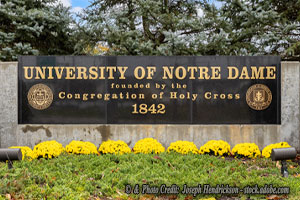
The debate over the hiring of Prof. Susan Ostermann as director of Notre Dame’s Liu Institute for Asia and Asian Studies is over. It triggered a massive uproar that surprised many by its intensity. In the end, the appointment was a carefully managed and measured defeat for the school’s administration, which was forced into damage-control mode.
Prof. Ostermann announced that she declined her appointment as director because the controversy “risks overshadowing the vital work the Institute provides.” The administration calmly accepted her decision, with little commentary or apology. This solution sought to end the affair without embarrassment or admission of guilt.
Bowing to the Pressure
However, those opposing the radical pro-abortion professor’s selection could celebrate victory since there is no doubt that the pressure had its effect. No one was fooled by the withdrawal maneuver. Protests work, and this one fully achieved its very limited objective.
News of the resistance and victory is all over the media. Some twenty bishops nationwide asked, not demanded (as is their right), that the university reconsider. Local Bishop Kevin Rhoades even led a rosary at the university’s Lourdes grotto for the intention.
Gen Z students were the driving force behind this battle for their Catholic identity. Two professors cut ties with the Institute. Alumni and benefactors threatened to withhold financial support. A TFP Student Action petition gathered some 12,000 signatures. A kind of religious civil war was brewing.
Suddenly, a deal was struck, and the administration now hopes to return to “normal” after the bout of unpleasantness.
Why It Was Important
Yet an uneasiness lingers among those who fought so hard for this cause. This protest was different from so many others. It uncovered a vulnerable flank in the Catholic left.
The conservative victory at Notre Dame was important for three reasons.
The first reason is that the appointment of the pro-abortion Prof. Ostermann made the connection between the moral positions of the professor and her intellectual work. People saw clearly that a radical pro-abortion professor should not head a major institute inside the nation’s premier Catholic university. The appointment scandal crystallized reactions all over the country.
Catholic protesters nationwide rejected the strong liberal premise that affirms that moral positions are private matters that should not condition academic and administrative decisions. Protesters did not budge from the truth: Higher learning is not divorced from morality.
It does not matter if the director teaches Asian studies. If she rejects perennial Church moral teaching, then she is unworthy to teach anything at Notre Dame.
Indeed, a person who cannot understand the logic of what constitutes the procured murder of an innocent unborn child may very well struggle to structure syllogisms correctly in other fields, as well, like the social sciences. A person who believes, for example, that there are dozens of “genders” is unqualified to teach biology.
Those who protest also saw that this is not an isolated incident. Many liberal Catholic universities throw away their identity and embrace error. The Notre Dame scandal points to a profound crisis in Catholic higher education that desperately needs to be fixed.
The Gen Z Factor
The second reason the affair was important is that it proved these issues are tremendously appealing to the Gen Z generation. The heart and soul of the Notre Dame protest were the students who insisted upon upholding Church teaching and identity.
This new development does not portend well for the left. Pro-lifers, for example, have often picketed the university for its liberal stances on abortion. Students were not a significant part of the massive protest on the occasion of President Barack Obama’s 2009 commencement speech at Notre Dame.
During this protest, however, students took a key role. Their participation embarrassed the administration, which took a deliberately anti-synodal stance, refusing to listen to or accompany those who hold a contrary viewpoint. The administration’s cold refusal to engage in “dialogue” revealed its insincerity and dearth of intellectual honesty.
The leftist myth that says young people always lean leftward is false. The Notre Dame protest was a breath of fresh air.
Cracks in the Wall
The final reason why the protest was important was that the protesters won. As an Establishment institution, Notre Dame often prefers to ignore or wait out significant reactions.
Thus, there have been many wholesome conservative reactions on campus over the years, but rarely do they achieve complete victory.
In the case of Prof. Ostermann, the protesters had a very limited goal: blocking her appointment. They achieved that goal completely despite the maneuver to make it seem like a personal decision. Notre Dame caved in.
This victory is significant because it indicates cracks in the liberal Catholic walls that defend secular higher education. If such results can happen once, they can happen again. Determined protesters managed to prevail. They need to do so much more often.
A Need for Daring
The victors must not rest on the laurels of this very limited yet complete victory. Protesters need to pursue the victory. If they really want to restore Notre Dame’s Catholic identity, there are plenty of targets inside the gold-domed citadel and in the broader universe of Catholic higher education.
For example, Prof. Ostermann was not being hired for the role but promoted. She has been on the Notre Dame faculty for many years. Her withdrawal from the promotion does not affect her continued employment. This unapologetic pro-abortionist remains on the Notre Dame payroll with all the accompanying prestige and privileges.
The present incident indicates that change can be wrought by those who dare. Those who protest need the courage to challenge the Notre Dame administration and demand a full return to this university’s Catholic and Marian roots.
Photo Credit: © Joseph Hendrickson – stock.adobe.com
First published on TFP.org.