


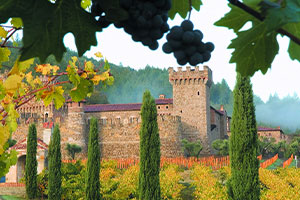
The story of wine is really the story of civilization refining something simple into something meaningful, complex, and beautiful. It begins in the ancient Near East, where wine already carried prestige in Mesopotamia and Persia, tied to royalty and ritual rather than everyday life. The Greeks elevated it further into culture by weaving it into philosophy, religion and social identity—while the Romans turned it into an empire-wide industry.
Wine plays an important role in the Bible. It is associated with celebration, blessing and hospitality, and is notably present in Christ’s first public miracle at the wedding at Cana, where He transforms water into wine. Later, at the Last Supper, Christ gives bread and wine to His Apostles, instituting the Eucharist. In Catholic theology, the bread and wine become His Body and Blood through transubstantiation.
After Rome’s fall, monasteries preserved and advanced winemaking, treating it as essential infrastructure because of its role in the Catholic Mass. Benedictine and Cistercian monks became long-term observers of vineyards, tracking soil, slope, harvest timing and fermentation outcomes over generations—gradually forming the early concept of terroir and laying the groundwork for modern wine classification systems.
In the medieval Christian world, wine’s meaning deepened through its sacramental role in the Church. This sacred function gave monks a unique responsibility: they were not simply producing a beverage, but preparing the elements for divine worship.
Monastic vineyards thus became centers of precision, discipline, and preservation of agricultural knowledge. Wine also carried practical importance—it was safer than most water sources and supported monastic self-sufficiency. Over time, wine came to be seen as something to be refined, protected and dignified. By the Renaissance, it had fully transitioned from a regional agricultural product into a symbol of status, culture, and sacred tradition—its identity shaped as much by theology and ritual as by soil and climate.
Some attack the influence of any elevated element of Western civilization. These would see the proper appreciation of wine as an expression of order, refinement and civilization.
This attack can be understood in the context of a historical process that Prof. Plinio Corrêa de Oliveira describes in his book Revolution and Counter-Revolution. He refers to what he calls the “Revolution” as a long historical process attacking Western civilization in the late Middle Ages. It led to disorder, leveling, and the rejection of inherited forms of authority and tradition. It would naturally attack the refinement of wine over the ages and favor the disordered passions that abuse alcohol.
The “Counter-Revolution,” by contrast, is the response to this tendency: the restoration and preservation of order, hierarchy and meaning within Christian civilization. It sees these cultural developments as an advance in appreciating and understanding the God-given order.
In this context, wine serves as an example of how a natural good can be elevated within Christian civilization or diminished when detached from higher meaning. From a Counter-Revolutionary perspective, it is not merely an alcoholic beverage but a cultural product shaped by centuries of order, hierarchy, craftsmanship, and religious meaning. It reflects the principle that material things are perfected when directed toward a higher end and one’s sanctification.
Revolutionary currents reject this development in favor of leveling, unbridled passion and immediacy. The cultivation of wine is meticulous and patient, requiring long periods of aging and reflection that stand in contrast to a culture of instant gratification. Even its proper enjoyment—through careful serving, attention to detail, and deliberate tasting—reflects restraint and appreciation rather than excess.
To truly appreciate fine wine, one observes its appearance, senses its layered aromas and sips slowly to perceive its structure and development in the glass. Just as wine matures over time in the barrel, it continues to open and evolve as it breathes. Rushed consumption flattens its character and conceals the craftsmanship behind it. In this sense, wine naturally lends itself to temperance, one of the cardinal virtues, and is understood as the proper ordering of desire under God. Temperance is opposed to the Revolution’s disorderly appetite and helps align human action with reason and restraint.
The Revolution’s hatred of inequality would lead to a rejection of the structured world of wine and its excellence. Its followers would favor other drinks that more easily fuel overindulgence in impulse and gratification. It prioritizes the present moment without regard for consequence, and in doing so, it separates human action from godliness and the proper hierarchy of virtue.
So sit awhile, reflect and enjoy a fine wine in the spirit of the Counter-Revolution.
Photo Credit: The American TFP