



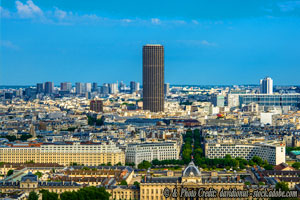
The lone skyscraper within the city limits of Paris stands empty as its owners ponder its future. It is a tale of government bureaucracy, artistic hubris and greed-soaked speculation that simply boggles the mind.
At the center of the tale is the Montparnasse Tower—a building so monumentally ugly that The New York Times referred to it as “the box the Eiffel Tower came in.” A common Parisian witticism holds that its observation deck is a popular destination because it offers the only view in the city in which the tower itself cannot be seen.
The Birth of an Eyesore
The story of this architectural disaster is considerably older than the tower itself. Before it was a tower, Montparnasse was a neighborhood that lies at the intersection of the sixth, fourteenth and fifteenth arrondissements—three of the twenty administrative districts that have divided the city since the end of the French Revolution.
From the turn of the twentieth century until World War II, the area was called the Beehive, a collection of ramshackle living quarters and studios of painters and sculptors. However, the war hit the area hard, and by the late fifties, it was a rather derelict area best known for its railroad station.
Just as it did in slum-prone American cities, the germ known as “urban renewal” infected Parisian bureaucrats. Montparnasse appeared to be an exemplary location for their ministrations. Soon, elaborate plans to demolish and replace the old neighborhood were developed. A high-rise utopia could, the bureaucrats argued, replace the old railroad station, the seedy businesses and shabby apartments with a modern enclosed mall and offices.
However, Parisians take their city’s place in European culture and history seriously, so the plans were heavily scrutinized. It took over a decade for demolition of the thirty-acre site to be completed. The first of its fifty-six footings was poured in 1969. The controversy did not lessen as the tower took shape. When opened in 1973, the new tower was instantly branded an eyesore. Not only did its 689-foot bulk dominate the skyline, but its tobacco-brown glass exterior box also clashed with the ambiance of the “city of light” that had taken its well-known form a century earlier.
In 1977, Paris officials guaranteed that no comparable abominations would be allowed by limiting the height of any new construction within the city limits to 37 meters (roughly 121 feet).
Troubling Times Ensue
To many Parisians, Montparnasse became a symbol of utility taking precedence over beauty. As time passed, however, Parisians stopped looking at and complaining about it, much as a chronic sore back becomes an expected part of daily life to be ignored, if possible.
Like most urban development dreams, Montparnasse never lived up to the vision set out for it. Its railroad station eventually handled sixty-one million passengers each year, so there was foot traffic for the retail space and the “open plan” offices were convenient. Eventually, about 300 individuals and businesses purchased parts of its space.
However, trouble lay ahead. In 2005, inspectors discovered a considerable amount of asbestos insulation. Perhaps the planners, architects and occupants began to think that the need to remove the asbestos could be turned into an opportunity. Maybe lighter, more thermally efficient panes could replace the dark brown exterior glass. Some empty office space could be repurposed into hotel rooms with magnificent city views. Strategically placed balconies could break up the rather oppressive bulk of the structure itself. Plantings could enliven the observation deck. The retail spaces could be remodeled into something more upscale. The whole renovation would cost, according to Radio France Internationale (RFI), “just over €300 million.”
Inevitable Roadblocks
However, three problems confronted the project. First, there was no single building owner to approve the plans and pay the bills; there were roughly three hundred. Decision-making, predictably, slowed to a snail’s pace. Eventually, some of the larger owners bought out the smaller, but such negotiations took time. Then, there were the French and Parisian bureaucracies whose regulations and concerns required attention. More time passed. All the while, the projected costs continued to rise until a manageable €300 million ballooned to €800 million, necessitating the refinancing of the entire project at far higher interest rates.
Then, local officials and other groups contributed their opinions. The New York Times article quoted Philippe Gougon, the Fifteenth Arrondissement’s conservative mayor, saying that he would like to demolish the building but accepted that redevelopment was the best economic choice. His counterpart in the neighboring Fourteenth Arrondissement, Carine Petit of the Ecologists’ Party, objected that the project did not provide enough publicly accessible open space, opining that “Paris [doesn’t] need another shopping center.” Then an animal-protection group argued that redevelopment would disrupt the lives of a pigeon colony living in the former shopping center. “OK, they’re not necessarily very popular, but they’re there, they exist,” the tree-huggers said. “All they want is to start their families, raise their young.”
Dashed Hopes, Again
At long last, the final hurdles had seemingly been cleared. In January 2026, word went out that the remaining tenants would be relocated and that the observation deck would close on March 31 for an estimated three-year period. A Paris tourist site, Sortir a Paris, crowed, “Montparnasse is being reborn, from the skyline to the street level, and the tower is set to shine anew… transparent, green, and full of life!”
Then, that life flickered and died. On October 30, the Spanish-language newspaper El País reported that the owners had been unable to obtain financing after all. “The ambitious renovation plan, which over the past decade involved four renowned architectural firms, now appears to have been shelved: no luminous new façade, no hotel and no rooftop garden.”
Meanwhile, the “memorandum of understanding” with the city that allows the project will expire on November 30. Obviously, more chapters lie in store for the massive building that nobody likes.
Sic transit gloria mundi!
First published on TFP.org.
Photo Credit: © davidionut– stock.adobe.com