


Many historic parishes around the United States rejected the architectural embellishments that marked them as distinctively Catholic during the roughly thirty years after the Second Vatican Council. Many parishioners mourned as high altars, murals, windows and other features were carted away, covered over, or simply destroyed. Others silently wept as sacred decorations provided by the sacrifices of their ancestors gradually faded and decayed as time’s ravages became increasingly visible.
Fortunately, it appears that the wanton vandalism has ceased. In recent years, many historic parishes have restored their buildings to their rightful places as beacons of the faith in an increasingly ugly world.

Well-Earned Recognition
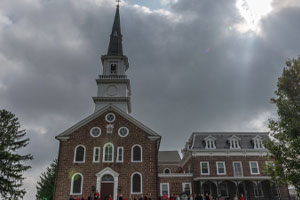
Recently, Preservation Pennsylvania, a state-chartered nonprofit organization, gave its annual Restoration Award to the Basilica of the Sacred Heart near Hanover, Pennsylvania. It is also known by its historical name, Conewago Chapel.
Until recently, it was an impressive structure, but peeling paint and the residue of years were obvious. Now, its plasterwork and murals restored, it glows.
Preservation Pennsylvania noted the magnificent work in a brief statement.
“A landmark of American Catholic history, the Basilica underwent an extraordinary restoration to uncover and conserve its nineteenth-century Baroque interior, including the largest historic paint exposure the conservation team had ever encountered. The work restored original decorative painting, fine art, woodwork, marble altars, and illusionistic artistry—reviving the sacred space’s spiritual and artistic power.”
Mother Church of the Harrisburg Diocese
The parish, designated a minor basilica in 1962, has a long and distinguished history. The Jesuits founded it in 1730, and it served as the headquarters of the order’s missionary efforts in Pennsylvania and western Maryland. The current structure—then the largest Catholic church structure in the new United States—was completed in 1787, although it has been expanded frequently in the intervening years.
Why America Must Reject Isolationism and Its Dangers
In 1937, the sesquicentennial of the building’s dedication, then-Bishop George L. Leech of Harrisburg summarized its importance.
“Conewago belongs to America, not merely to a parish or a diocese because it was the gateway through which passed the saintly founders and zealous missionaries who carried the light of the true faith eastward and westward into the frontiers of our land, long generations before the founding of our beloved nation.”
Baroque on the Frontier
Stylistically, the Basilica is clearly the result of many hands. Its exterior is rather plain, especially as built initially without its prominent tower and steeple, added in 1851 and 1873, respectively.
The interior is an altogether different matter. In the 1840s, the Jesuits brought in a muralist, known today only as Gebhart of Philadelphia, who had decorated their Gesù Church in Philadelphia to paint the ceilings and walls in the Baroque revival style. The highlight of Mr. Gebhart’s work is a magnificent depiction of Our Lady’s Assumption on the ceiling.
Help Remove Jesus Bath Mat on Amazon
About 1850, the building’s interior assumed its current size and shape. In addition to the tower, the Jesuits added the transept and apse. They brought in Austrian artist Franz Stecher to complete the new spaces in a style that would complement Mr. Gebhart’s work.
Gradual Deterioration
Mr. Stecher’s work did not remain untouched for long. About 1887, the apse sustained significant water damage, and the area was redecorated by the Philadelphia “artist and decorator,” Lorenzo Scattaglia and Filippo Costaggini. Mr. Costaggini is better known for his work in the U.S. Capitol Building. In 1901, Mr. Stecher’s painted Stations of the Cross were replaced with bas-relief representations. That same year, the Jesuits turned over Conewago Chapel’s administration to the Diocese of Harrisburg.
Through the twentieth century, natural forces of deterioration affected the painted Baroque decoration. As the murals needed repairs, less skilled hands overpainted the originals. Rather than spending parishioners’ donations on restoring “old-fashioned” panels, some were simply painted over.
The Forces of Modernism
However, such common factors were as nothing compared to the wholesale butchery that happened in many parishes as a result of “the spirit of Vatican II.” The National Conference of Catholic Bishops’ 1978 Environment and Art in Catholic Worship expressed the new mode of church decoration.
Satanic Christ Porn-blasphemy at Walmart — Sign Petition
The new guidance eschewed monumental buildings. The overall scale of “worship spaces,” the Conference urged, needed to be “human.” Barriers like altar rails were anathema. Worshippers in the “assembly”—a new word for congregation—should be able to see each other’s faces, especially the priest’s. Being a full participant in the “worship experience” was vital.
In such a milieu, traditional Catholicism’s painted and carved decorations stood no chance. The trend was toward radical simplicity. Traditional decorations distracted the “assembly’s” attention. Simple wooden tables in the midst of the pews substituted for large and heavily carved high altars against the far wall. Simpler designs often replaced ornamental Victorian stained glass. Monumental paintings, such as those in Conewago’s Sacred Heart Basilica, were to be painted over if possible and deliberately ignored if necessary.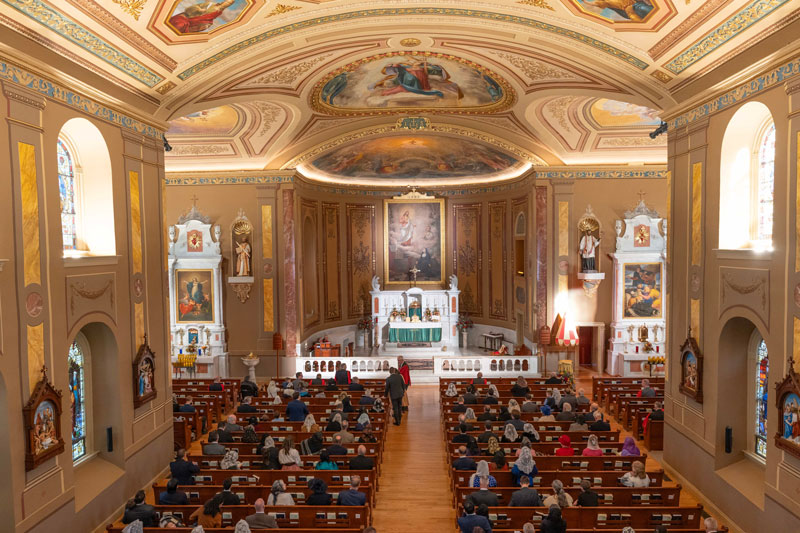
A Skillful Restoration
So, much of the original artwork had been “lost” by the sixties. It fell to the restoration experts at Canning Liturgical Arts to recover and restore some of the Basilica’s nineteenth-century grandeur.
How Panera’s Socialist Bread Ruined Company
In the National Catholic Register, one of the restorers, Canning’s David Riccio, summarized the process.
“I started to do these huge paint exposures, peeling back layers of paint, and I found the [nineteenth century] decoration fully intact in many cases. It was miraculous. This turned from a replication project into what we call conservation or preservation project, where we salvaged all the historic fabric on those ceilings and walls, and then we did repairs to them. And that usually doesn’t happen.”
In a series of articles she did for Canning’s website, the company’s resident art historian, Amy Marie Zucca, placed the restoration into its proper perspective. Her conclusion is especially apt.
“In 2023, Canning Liturgical Arts revealed and restored all that the Jesuit missionary priests sought to raise on that rural hill in Hanover: A Mother Church in her own right. The ‘Mother Church to the Pennsylvania missions.’ The ‘Mother Church of the Diocese of Harrisburg.’ The ‘Mother Church of Pennsylvania west of the Susquehanna.’ In 2023 Catholics can look to Conewago again.”
Reclaimed Magnificence
What Does Saint Thomas Aquinas Say About Marriage?
Now, congregants could see the Basilica as John T. Reilly presented it in his 1885 book, Conewago: A Collection of Local Catholic History.
“Watch the old building with anxious care. Guard it as best you may…. Count its stones as you would jewels of a crown…. And do this tenderly, and reverently, and continually, and many a generation will still be born and pass away beneath its shadow.”
When surveying the newly-restored magnificence of Sacred Heart Basilica, one can almost envision a day when the beauty of traditional Catholicism can wash away some of the self-inflicted wounds of the sixties.
First published on TFP.org.