


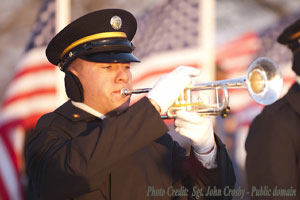
Few things are more moving than a military funeral, most especially one where “Taps” is played. It is enough to make a grown man cry, and many have.
Those who have performed this emotional music piece describe how a chill runs down their spine when they render the final salute to a hero. Each time is unique.
That was true until the introduction of a “canned” version. The human element is now often replaced by a recording amplified with a boombox or a fake trumpet. Thanks to one Marine and thousands of volunteer buglers, a live performance of “Taps” is being revived.
History of Taps
The music was created in 1862 by Union General Daniel Butterfield, who wanted a bugle call to signal “lights out.” He took a more complicated tune, “Scott Tattoo,” written by Winfield Scott in 1835, and simplified it.
His version of the melody was first used in a funeral by Capt. John B. Tidball for one of his soldiers, who died during the Peninsular Campaign in Virginia during the Civil War. The proximity of the enemy made it unsafe to fire the traditional three volleys over the grave of the fallen warrior. He thus opted to play Butterfield’s music. Hence, a marvelous tradition that would soon become legendary was born.
What began as a calming way to end the day and later became a formal part of military funerals has an ethereal beauty that invites mourners to higher reflections.
The memorable moment of playing “Taps” was tarnished for many families with the passage of a piece of legislation that would significantly impact many military funerals.
The Ceremonial Bugle
In 1999, Congress passed a law that guaranteed every eligible veteran a minimum of three-person funeral honors, which includes the folding and presentation of an American flag and the playing of “Taps.” The demand for musicians grew, and, like most things in our post-industrial world, the sublime was sacrificed on the altar of practicality and secularism.
The same 1999 laws stipulated that if an actual bugler is not available, “the funeral honors detail shall play a recorded version of Taps using audio equipment… for use at the funeral.” When it came time to bury their loved ones, family members were shocked to see a boombox instead of a bugler.
In 2003, Simon Britton created the Ceremonial Bugle, which features an internal electronic device hidden inside a bugle. With a simple push of a button, a pre-recorded version of Taps from a funeral at Arlington Cemetery comes out.
The problem with this, say some bugle players, is that it is too perfect. Those who rely on this option also fail to realize what can happen if the bugle fails, as it has at Cape Canaveral National Cemetery in Mims, Florida.
Cape Canaveral National Cemetery
On a beautiful fall morning, I attended a funeral for an Iraq veteran and saw the Ceremonial Bugle in action. The person impersonating a musician pushed the button and pretended to blow into the horn. In this instance, everything went well, but that is not always the case.
The person in charge of that particular funeral, who will remain nameless, has personally witnessed embarrassing mishaps. There are times when a bugle’s battery fizzles out and, along with it, the song.
On other occasions, the bugler presses the button, and nothing happens. Thus, the cemetery was forced to install a backup system, wired into the Committal Shelter, with two speakers behind the platform holding the coffin. When the Ceremonial Bugle fails, an employee must run over and push the button to obtain an equally fake version.
This cannot help but leave a bad taste in the mouth of mourners whose loved one fought and sometimes died on the battlefield.
This trend toward mechanical renditions did not sit well with Marine veteran Tom Day. When he first heard about the 1999 law and then listened to the recorded version of “Taps” at funerals, he decided to take action.
Bugles Across America
He knew many horn players and began spreading the word through an organization he founded, called Bugles Across America (BAA). What started in the basement of his Chicago home quickly grew into a nationwide movement with over 1500 buglers.
Along the way, there have been many memorable moments for volunteers, like nineteen-year-old Aidan Peterson.
When he was only five years old, he got a trumpet for Christmas. After playing one sound, he was hooked. It was not long before the boy with a gift became a young man with a purpose. He has played over 500 military funerals and explained, in poetic terms, how the song is like “telling the story of a soldier.”
His most moving experience occurred when he was asked to play “Taps” at the bedside of a Marine veteran who was being removed from life support at a Veterans’ Administration hospital. It was then that he understood how “music is like medicine.”
“Music Is More than a Series of Mechanically Reproduced Notes”
Leo Murphy is the Florida State Director for Bugles Across America and has similar moments. He described himself as a singer who never played an instrument till he purchased a bugle and took music lessons. It only took him two weeks to learn “Taps” and become a certified BAA bugler.
He rarely gets emotional when playing the music. An exception was the final farewell of an Army Ranger. The soldier’s wife held their newborn infant and was barely able to contain her grief as she sat in front of her husband’s coffin. With the first notes of “Taps,” she felt the full impact of her loss and let out a cry of pain. The scene was so gut-wrenching that Mr. Murphy also got choked up and feared he would not get the following note. He managed to keep it together and finish the tribute to honor one who had bled for our country.
Thanks to the initiative of Tom Day, Bugles Across America volunteers can now fulfill 75% of requests for a live version of the soul-stirring tune and have played at over 350,000 funerals.
A Song that Conveys Emotion
Some will argue there is no difference between a recording of the song and a live bugler. Mr. Murphy strongly disagrees.
“Music is more than a series of mechanically reproduced notes,” he argues, “it can convey emotion.” He experienced this first-hand when he played “Taps” for the annual Memorial Day ceremony in St. Cloud, Florida. His bugle instructor, who holds a master’s degree in music, was present and noticed something different.
“He had heard me play ‘Taps’ many times before, but never with the emotion he heard that day,” Mr. Murphy said. “That was when I told him that, minutes before, I received a message that my father had just passed away. Buglers put heart and soul into ‘Taps,’” he concluded, “that no computer chip, MP3 and two AA batteries will ever have.”
Emotion can therefore be conveyed through the playing of a song. That is what millions of Americans saw when Keith Clark performed the most famous “Taps” in history at the funeral of President Kennedy. The pressure for perfection caused him to fumble the sixth note. The missing note became a poignant symbol of the nation’s collective sorrow and anguish. It struck many listeners as the sound of a broken heart.
This does not happen with a recording. That is why a Vietnam vet, draftee, once said, “If a recording of Taps is adequate for my funeral, I should have been able to send the Draft Board a photo of myself instead of reporting for duty.”
Master Sergeant Jari A. Villanueva understands the power of the song all too well. He has played the call at over 5,000 Arlington Cemetery funerals and succinctly summarized the sublime aspect of the music.
“Its echoes linger in the heart long after its tones cease to vibrate in the air,” he said. “Like Handel’s Largo, it is immortal.” The same could be said of those who made the ultimate sacrifice. Thanks to Bugles Across America, the legacy of those who have served still echoes in song over the coffins of warriors, and their bravery will never be forgotten.
First published on TFP.org.