

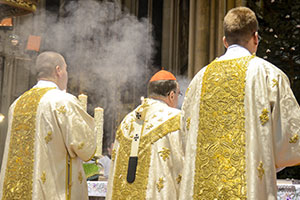
Numerous dioceses across the British Isles are seeing record numbers of incoming converts entering the Church this Easter, lending credence to what has been described by some as a quiet revival of religion across the land.
“The Holy Name of Jesus our Savior is what unites all of us here today, that He, through His Church, calls you by name.” Such was the invocation of Archbishop John Wilson of the Archdiocese of Southwark in the south-west of England at his recent Mass for the Rite of Election.
This Easter, Abp. Wilson—thought by many to be one of England’s most dynamic prelates—is due to welcome the largest number of people into the Catholic Church since the archdiocese’s record in 2011. Present at the February 21 Mass were 590 adults intending on entering the Church, with more converts due to swell their number at Easter. A full half of that number is aged 35 or younger, pointing to the current tide of young people seeking meaning and truth in an increasingly secular world.
Nor is Wilson’s archdiocese an isolated phenomenon. Indeed, Southwark is but one instance of a trend being replicated throughout England, Scotland and Ireland.
The Diocese of Westminster, home to England’s customary cardinalatial see, saw the largest number of adult converts on track to enter the Church in fifteen years. Some 800 people were welcomed by newly installed Archbishop Richard Moth, which is a sizable increase on 2025’s total of around 500.
Bishop Philip Egan’s Diocese of Portsmouth, which is in the south of the country, saw over 250 people attend the Rite of Election as they prepare to enter the Church. At the same time, his close friend, Bishop Mark Davies in the Shrewsbury diocese, experienced an unprecedented surge in numbers, requiring two ceremonies of the Rite of Election rather than one.
North of the border, the Archdiocese of Glasgow documented a 20 percent increase in the number of converts over last year, with 120 set to enter the Church. “If anyone doubted the quiet revival in Catholicism across the Western world, then this picture is the answer,” the archdiocese rejoiced. On the other side of the small nation, the Archdiocese of Edinburgh hosted 150 people at its own ceremonies.
Though by no means an exhaustive list, the trend emerging from these dioceses points not just to a renewed interest in the Catholic faith, but an interest unlike that seen for many years. This is not to say that Great Britain has suddenly become the populous Catholic center of the global Church. In pure numbers, it cannot yet compete with the size or growth of the Church in the U.S.
For example, the Archdiocese of Cincinnati is set to welcome almost 1,100 souls into the Church, the highest number since 2009, and the Archdiocese of San Francisco is also expecting many hundreds of new Catholics in a few weeks.
Yet it is the proportional growth of the faith in Great Britain which is to be marvelled at, particularly in a land where—unlike the U.S.—religion is not viewed as something acceptable in the public sphere, but more akin to a private side-project which should have no bearing on professional and public life, let alone public beliefs.
The state church, of course, is the Church of England. But recent years have seen the self-implosion of the Anglican body over various doctrinal disputes, and the accompanying—and by no means unrelated—steady growth of young, practicing Catholics outnumbering their Anglican counterparts.
Musing on this latter point, a Church of England publication wrote last year that people “are looking for something robust and obvious, rooted and real. And they are finding it not in denominational flexibility but in the ancient, global, and unyielding structure of the Roman Catholic Church.”
In the post-COVID years, it is no secret that many, particularly youth and young adults, have had their worldview upended. The daily life that had once been such a self-indulgent comfort was stripped away without warning, prompting a search for something deeper to cling to.
Recognizing this, the new bishop of the Diocese of Raphoe (in rural Ireland) delivered a homily last month in which he highlighted how this anti-Christian world eventually pushes people to seek faith. “Often converts they are drawn to doctrinal solidity, sacramental depth and continuity with the Church’s tradition. For them, the Church lies in truth that is intelligible in body and demanding, not adaptability.”
Young Catholics, he added, “having grown up amid constant choice, information overload and moral ambiguity are less interested in conversation and more in formation that produces conviction and confidence.”
Raphoe’s new ordinary is not alone in this observation. Commenting on the proportionally large numbers entering the Church, Father Stuart Chapple of the Diocese of Lancaster told this correspondent that “young people don’t want the church to change to suit the times but are coming to the Church for refuge against the prevailing storm of secularisation and relativism. That even if they’ve not read it, Benedict XVI’s prophetic words on the dictatorship of relativism are coming to fruition.”
For Fr. Chapple, this was a sign of encouragement, given that in the “often militant secular environment where so many agendas are being pushed, young people are finding the courage to go against the grain.” He observed how technology has led to many growing “distant from people and human interaction,” thus leading them to the community of the kind only found in the Church.
But also how the Church’s own life and sacraments are a pull in themselves: “Beauty and the liturgy have also been a significant factor. The liturgy celebrated well and with dignity attracts.”
Further south, Father Richard Duncan of the Birmingham Oratory bolstered this argument. Noting that the Oratory instructs its own converts rather than sending them to the Rite of Election, Fr. Duncan pointed to the Church’s clear teaching and divine purpose as being the pull that many experience.
“I would say what is attracting people to the Church (a) certainty and clarity in an age where there is so much doubt and confusion and (b) the orientation towards God—the capax Dei—that St Augustine said is at the heart of what it means to be a human being,” he opined. “Man has tried to live without this for centuries past, and it is demonstrable that he can’t. The Liberal Deist compromise is over. Either the West returns to traditional Christianity, or it abandons its Christian heritage altogether.”
In 1852, before he was created a cardinal, Father John Henry Newman delivered his famous “Second Spring” sermon at Oscott seminary, calling on Mary’s aid in the effort to reconvert England. “Shine on us, dear Lady, with thy bright countenance, like the sun in his strength, O stella matutina, O harbinger of peace, till our year is one perpetual May,” he implored.
For Shrewsbury’s Bp. Davies, his words and advice for the Church to be “a Church ready for converts,” must be recalled anew. “We must now be ready to support new converts who are seeking Christ and His Church amid all the confusions of our time,” he instructed his diocese.
Michael Haynes is an English journalist in the Holy See Press Corps. He serves as Vatican Correspondent for Pelican+ and Vatican analyst for The Catholic Herald, while readers can follow him at Per Mariam and on X @MLJHaynes.
Photo Credit: © Ajdin Kamber – stock.adobe.com
First published on TFP.org.