


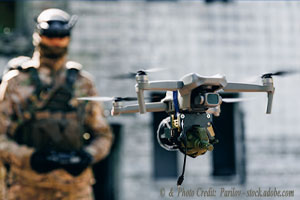
When Russia invaded Ukraine on February 24, 2022, few of the world’s governments and news media outlets gave them much of a chance of lasting longer than a couple of weeks at most. Nobody thought that Ukraine would become a proving ground for a new—and hitherto fore largely untested—technology. Now, experts around the world say that Ukraine has the best drones. Even more importantly, they have the best drone system.
Many well-respected outlets mention the worldwide demand for both Ukraine’s drones and its expertise in operating them. Forbes lists some elements of that system, “detection networks, command-and-control software, [and] cheaper interceptors.” Furthermore, and maybe even more important than the technological expertise is the presence of operators who developed their skills in the hardest classroom on earth—battle.
Expertise Born of Desperation
Ukraine did not set out to be the prime developer of one of the earth’s most modern weapons systems. This is a case of, as the old saying has it, necessity being the mother of invention.
Ukraine’s saga began in 2022 when Russian officials visited a drone facility in Iran. The factory’s specialty was cheap disposable drones. The Russians, whose tanks were bogged down in Ukrainian mud, liked what they saw. Drones could help Russia inflict great damage on Ukraine without troops or heavy equipment. They signed a deal to purchase 6,000 drones and license production of many more.
However, the Russians brought some of their own expertise to the project. They gave the cheap drones better navigational ability, more destructive warheads, and electronics that could defeat Ukraine’s attempts to “jam” the electronic signals that controlled the drones.
However, once again, the Russians underestimated the abilities of their Ukrainian foes. Yes, the drones injured Ukraine. It has sustained more than 57,000 drone attacks since 2022. Ukraine’s survival depended on innovation.
Creating a Better System
For Ukraine, the easy way would have been to purchase drones from the United States. However, there were two problems. First, the Biden Administration was happy to provide lip service to the valiant Ukrainians. Unfortunately, it was often reluctant to share weapons because feckless administrators feared escalation of the conflict more than a Russian victory. Second, the systems were far too expensive for a country already straining its economic resources.
Despite the problems, Ukraine had to respond effectively. They didn’t just build a better drone; they devised better ways to control them. In the process, they became a world leader in drone technology.
A reporter from the Associated Press (AP) visited Ukraine’s 127th Brigade. Brigade members, whose anonymity the AP protected, explained the process. “It’s not like we sat down one day and decided to fight with drones,” a pilot explained. “We did it because we had nothing else.”
A Spirit of Innovation
The Ukraine effort evokes a World War II phrase, “flying by the seat of his pants.” First, the Ukrainians took a single-use weapon designed to be disposable and found ways to reuse it. In the process, they studied the weapon’s weaknesses and devised ways to improve them. Each such tinkering session produced small results, but the overall result has been immense.
Justifiably enthusiastic, a pilot explained the Ukrainian spirit of innovation. “Just imagine—a Patriot missile costs about $2 million, and here you have a small aircraft worth about $2,200, and if it doesn’t hit the target, I can land it, fix it a bit and send it back into the air. The difference is huge.
Similarly, the Ukrainians developed a process that may be even more significant: the ability to use a drone to defend against another drone. A Ukrainian captain told AP about the day that a Russian reconnaissance drone hovered over the 127th Brigade’s position, transmitting information to Russian artillerists. The 127th used one of their drones to bring the Russian machine down.
“That’s when I realized—this is a drone war. It had begun,” the captain said. “We had been moving toward it for some time, but that was the moment I saw it with my own eyes.”
Wealthy Nations Ask for Help
Part of the advantage is the lack of bureaucratic involvement during the design, refinement and testing phases of weapons development. Ukraine simply does not have the time or resources for such luxuries. Forbes quotes a Ukrainian Army expert, Mark Savchik. “Ukraine can produce a long-range strike drone for roughly $200,000. Comparable systems from Western defense contractors could cost $5 million to $10 million.”
Now, it is the world’s turn to notice, and the Iranians are giving some of the wealthiest nations in the world reason to pay attention. According to the BBC, “Teams of Ukrainian military experts have been sent to Qatar, the United Arab Emirates and Saudi Arabia to help them defend against drones being launched from Iran in retaliation for the massive US and Israeli air attacks.”
The needs of these Gulf states are obvious to anyone who looks at a map of the places where the Iranian missiles have caused damage. A few are in Israel, Iran’s sworn enemy. However, Israeli defense systems have done a remarkable job of protecting their people. The real damage from Iran is in the other Gulf states. These nations thought that they could “sit out” the war until Iran, Israel, or both exhausted themselves. They never invested in defensive systems because they thought that such expenditures were unnecessary. Now, they know they need help and have the resources and willingness to pay for it.
Teaching the Teacher
In a very real sense, the bright, young Ukrainian student has become the teacher. The new students are from some of the wealthiest nations in the world.
So, where is the United States in this new picture? Well, it turns out that Ukraine’s hard-won expertise is helping America, too. Recently, the U.S. Army announced it would spend over $52 million to purchase 2,500 drones from a firm called Skydio. Fox Business Network interviewed Skydio’s CEO, Adam Bri.
In the discussion, Mr. Bri laid much of the credit for drone advancements at Ukraine’s door.
“Ukraine was the first striking data point for many folks, and it changes warfare fundamentally…. The [drones] we make are short range reconnaissance which operates at the soldier level. It’s very easy to put them in the air. It gives [the soldiers] real-time awareness of everything around them, and gives them the ability to make better decisions.” Such ability saves lives.
Throughout 2023 and 2024, it was not uncommon to hear Americans decry the U.S. investment in Ukraine. Now, those voices are largely quiet. Perhaps part of that newfound stillness is that Ukraine can use its experience to help keep American soldiers safer, increase their effectiveness and save taxpayer dollars. That is the sort of thing that happens when a good investment pays off.
Photo Credit: © Parilov – stock.adobe.com
First published on TFP.org.