

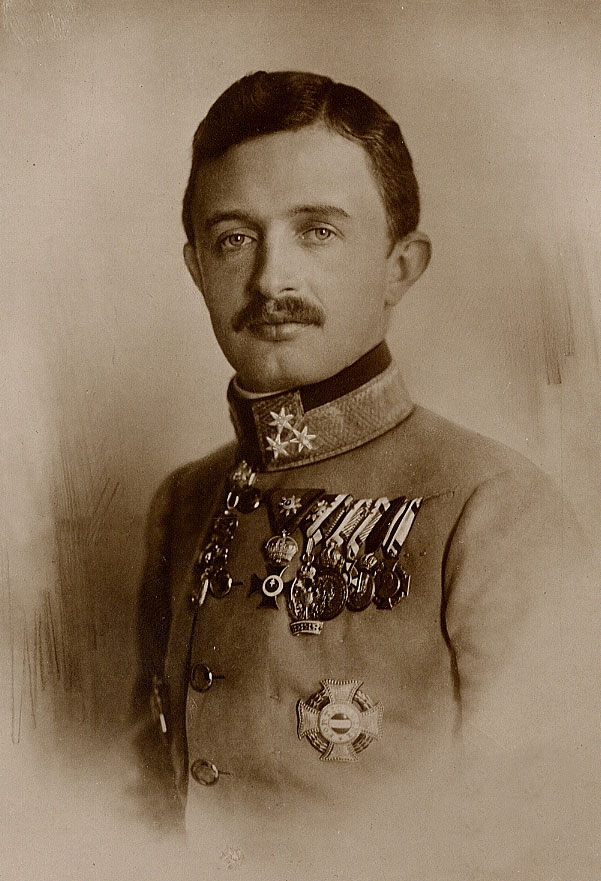
Today, October 21, the Catholic Church celebrates the feast day of Blessed Charles I of Austria, also known as Charles Habsburg. Curiously, we celebrate his feast day on the day he got married, not on the day of his death. He unexpectedly became Emperor of Austria-Hungary, witnessed the collapse of his empire, and died in exile at a young age. But who was this man? What heroic virtues did he embody?
A Pious Young Man
On the banks of the Danube, somewhere between Linz and Vienna, Charles Habsburg was born on August 17, 1887. His father, Archduke Otto Franz, was a man of his time and immersed himself in the frivolous lifestyle of the Belle Époque, while his mother, Maria Josepha of Saxony, proved to be a deeply devout woman. She therefore had a crucial influence on Emperor Charles’s later life.
In addition, there was also his grandfather’s third wife, Princess Maria Theresia of Braganza. This Portuguese princess was a pious Catholic. After marrying off her son and six daughters, she entered a convent. Her loyalty to Charles proved so great that she followed him into his later exile.
From a young age, he proved himself to be virtuous. When he received his First Communion in 1898, at the age of 11, one of those present remarked: “If one did not know how to pray, it is from this young man that one would learn!” He also attended Holy Mass daily with his mother and prayed the rosary.
Empress Zita
Archduke Charles and Princess Zita met at a very young age in Schwarzau, where they paid little attention to each other. At that young age, the four-year age difference seemed like an eternity! So they each played with their own age groups.
Princess Zita came from the noble House of Bourbon-Parma. Her father was unequivocal: “We are French princes who ruled in Italy!” Shortly before that, the family had lost its throne on the Italian peninsula to the revolutionary unifiers.
After not seeing each other for a long time, Archduke Charles was sent to Brandeis on the Elbe to serve with the dragoons. When he visited his favorite aunt, Archduchess Annunciata, who was in the area in 1909, the young Princess Zita was there as well. They became close friends.
Shortly thereafter, in 1910, with Emperor Franz Joseph’s permission, Charles asked her to marry him. She agreed, and in the summer of the following year, they tied the knot.
After the engagement Mass, Charles told Zita: “Now we must help one another to gain Heaven!”
They got married on October 21, 1911. This date later became the feast day of Blessed Charles I of Austria. They were married in the same castle where they first met as children—Schloss Schwarzau.
High-ranking nobles from all over the world gathered there, and the solemn High Mass was celebrated by Monsignor Gaetano Bisleti, a personal representative of Pope Saint Pius X. They asked the Blessed Virgin for her blessing on their marriage and had the words “Sub tuum praesidium confugimus, Sancta Dei Genitrix” engraved on their rings.
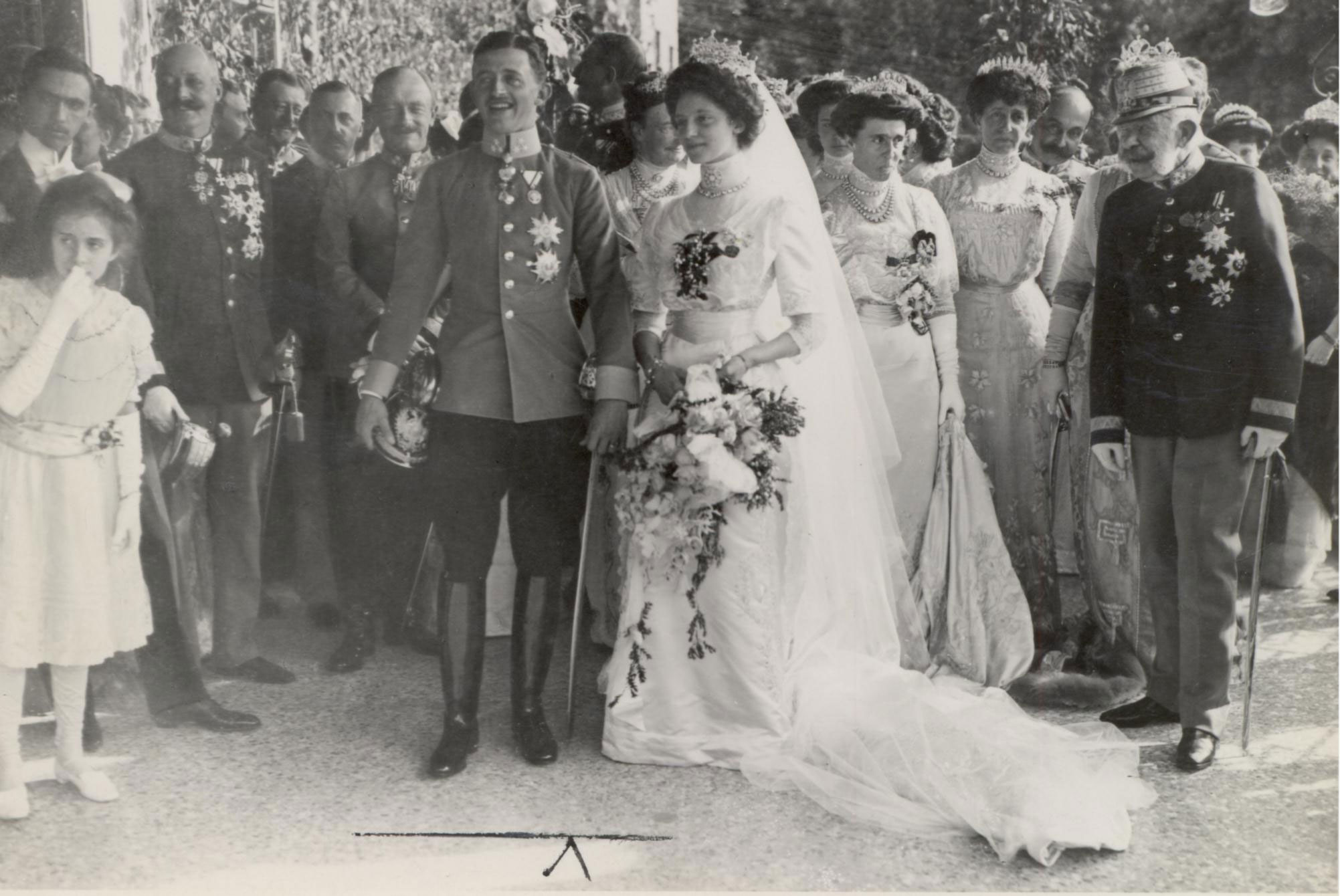
Many telegrams were sent to congratulate the young couple, including one from Victor Emmanuel, King of the newly unified Italy. He was, in fact, the very man who had dethroned Zita’s father. Laughing, Emperor Franz Joseph remarked, “That was certainly not sent with a willing heart.”
Together, they would have eight children, including the last crown prince of Austria-Hungary, Otto von Habsburg. On the day of Otto’s First Communion, Charles consecrated his family to the Sacred Heart of Jesus.
On the Way to the Throne
When Princess Zita made a pilgrimage to Rome before her wedding to ask Pope Pius X for his blessing on their marriage, the Holy Father said to her upon receiving her: “I am very happy with this marriage, and I expect much from it for the future… Charles is a gift from Heaven for what Austria has done for the Church.”
A little later, St. Pius X referred to Charles as the “heir to the throne,” whereupon Princess Zita politely corrected him by saying that Archduke Franz Ferdinand was the heir to the throne. The pope stood his ground and said that Charles would soon become emperor. Princess Zita was certain: “ I am sure Franz Ferdinand will not abdicate,” to which the pope replied: “If it is an abdication . . . I do not know.” Thus, he had a presentment that Charles would soon shoulder the heavy burden of the imperial throne.
Franz Joseph was only his great-uncle, and yet he would later become emperor. This was due to a series of tragedies within the family.
When Crown Prince Rudolf, Franz Joseph’s only son, died in 1889 without male heirs, the emperor’s brother, Archduke Charles Louis, became heir to the throne, since his older brother, Maximilian, had left for Mexico to become emperor there. He was assassinated there by Mexican revolutionaries. After Charles Louis died in 1896, the claim to the throne passed to his eldest son, Franz Ferdinand. However, he married someone of lower nobility, which meant his children could not claim the throne. Charles, the son of Charles Louis’s youngest son, Otto Franz, moved up in the line of succession when his father died in 1906. After the assassination of Franz Ferdinand in Sarajevo in 1914, Charles became the direct heir to the throne.
Thus, Charles, who was sixth in line to the throne, became the first in line due to all those disastrous events.
One evening in 1914, just before World War I, Crown Prince Franz Ferdinand invited Charles and Zita to dinner. After Franz Ferdinand’s wife left the room briefly to put the children to bed, he said to the young couple: “I have something to say, but I must say it quickly, as I don’t want your aunt to hear any of this when she comes down. I know that I shall soon be murdered. In this desk are papers that concern you. When it happens, take them. They are for you.”
Charles was speechless. Franz Ferdinand even said that their tombs in the crypt at Arstetten Castle were already ready.
World War One
Archduke Franz Ferdinand’s prediction proved true. He and his wife were assassinated in the summer of 1914 by Gavrilo Princip, a Bosnian Serb nationalist. This assassination would trigger World War I, in which millions of lives would be lost. Emperor Franz Joseph’s words were therefore not without reason: “Nothing is spared me.” He lost his son, wife, brothers, and nephew, and now found himself unwittingly caught up in a world war.
As a result, Archduke Charles became first in line to the throne. He was immediately sent to various fronts, including both Russia and Italy. Charles’s officer’s sword bore the inscription, just as his wedding ring did: “Sub tuum praesidium confugimus, Sancta Dei Genitrix.”
Princess Zita visited Franz Joseph on Charles’s birthday, since Charles was at the front. On that very day, the Austro-Hungarian army won a major victory over the Russians. When the princess congratulated the emperor on this, he said: “Yes, it is a victory, but that is the way my wars have always begun, only to end in defeat. And this time it will be even worse. They will say I am old and can no longer cope, and after that, revolutions will break out, and then it will be the end.”
On November 21, 1916, in the midst of the war years, Emperor Franz Joseph’s 68-year reign came to an end. He died at the age of 86. With that, the young Archduke inherited this vast empire, which was teetering on the brink of collapse. In the room where the recently deceased emperor lay, Prince Lobkowitz said, “May God bless Your Majesty!” as he made the sign of the cross on his forehead.
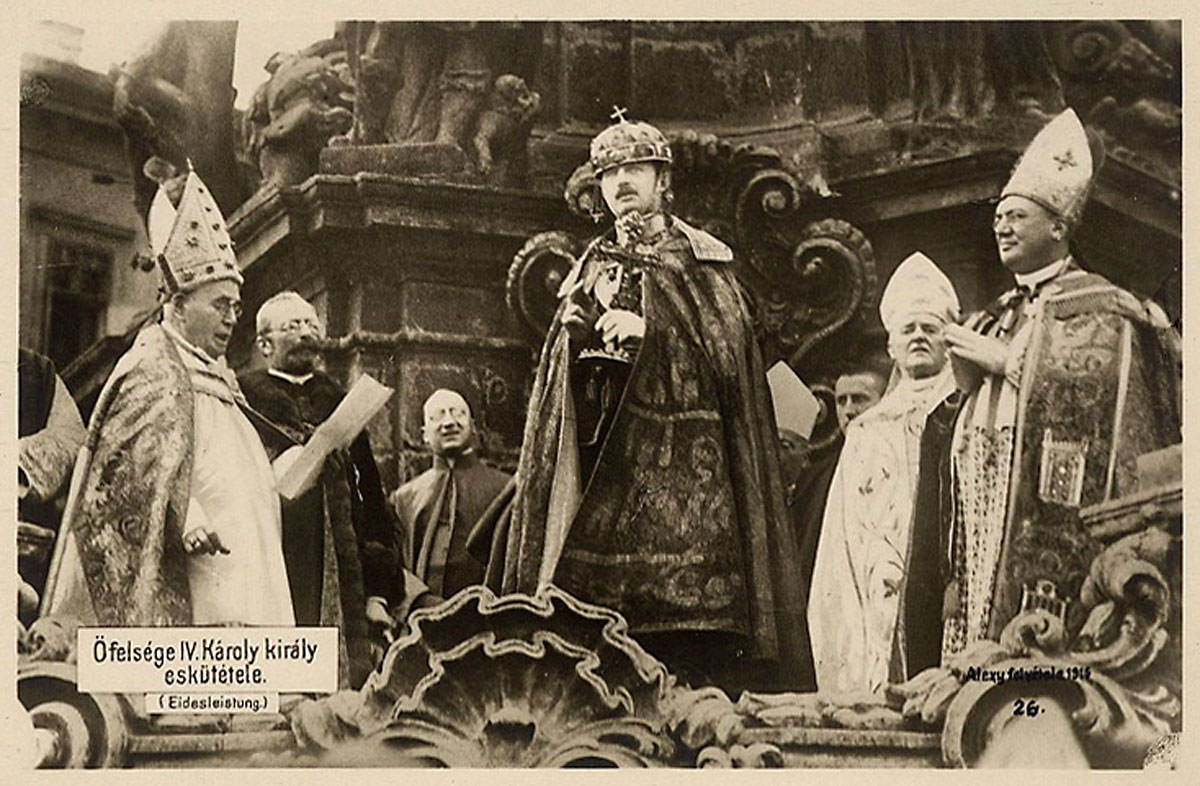
Soon after, on December 30, 1916, Charles was also crowned King of Hungary in Budapest. Thus began his brief but pious reign. After the coronation with the Crown of Saint Stephen, he said: “To be king is not to satisfy an ambition, but to sacrifice oneself for the good of the whole people.” He then also said: “No man can take from me the fact that I am the crowned King of Hungary!”
The Fall of the Empire
After losing World War I, the entire Empire fell apart. On November 11, the day of the armistice, Emperor Charles I issued a proclamation giving the Austrian people the choice of which form of government they wanted. In a later letter to the Archbishop of Vienna, however, he explained: “I did not abdicate, and never will… I view my manifesto of November 11 as the equivalent of a check that a street thug forced me to write at gunpoint… I do not feel bound by it in any way whatsoever.” He also issued a similar proclamation to the Hungarian people.
After the proclamation of “German-Austria” and the Hungarian Republic, Blessed Charles went into exile in Switzerland. Upon his departure, however, he declared: “Whatever the National Assembly of German-Austria has resolved with respect to these matters since November 11 is null and void for me and my House.”
In 1921, he made two attempts to regain the Hungarian throne. He received support for this from France, among others. Unfortunately, Blessed Charles was betrayed by his former commander of the Imperial and Royal Navy and current regent of Hungary, Miklós Horthy. Later that year, the Habsburgs were officially deposed.
Madeira
After his failed attempt to reclaim his rightful throne in Hungary, he was exiled to the Portuguese island of Madeira. At the same time, small socialist uprisings were taking place in Austria and Hungary. Consequently, there were fears for his life, prompting King George V to decide to provide him with an escort to Madeira.
On November 19, 1921, he and his family arrived on the island. A few months later, in March, Blessed Charles caught a cold that spread to his lungs. This pneumonia proved fatal. On April 1, 1922, Blessed Charles died at the age of 34. Empress Zita held a cross beside his bed, and his last words were: “Thy holy will be done. Jesus, Jesus, come! Yes—yes. My Jesus, thy will be done – Jesus.” He left behind his wife and children.
Blessed Charles, pray for us!