



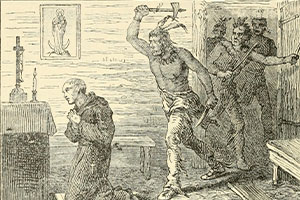
On September 13, 1597, a Guale warrior named Juanillo attacked and killed Father Pedro de Corpa in what is now the state of Georgia.
On All Hallows’ Eve (October 31), 2026, Father de Corpa and four companions, Fathers Blas Rodríguez, Miguel de Añón, and Francisco de Veráscola, as well as Brother Antonio de Badajoz, were declared Blessed in a Holy Mass in Savannah, Georgia. Frank Cardinal Leo, Metropolitan Archbishop of Toronto, celebrated the Mass. In his homily, the Cardinal referred to the five men as “shining witnesses of the Gospel.”
The four-and-a-quarter-century trip between those two points illustrates the power of virtue over political expedience.
A Vanished Tribe
The Guale were an Indian tribe located along North America’s Atlantic coast, primarily in the modern State of Georgia. According to the Franciscan missionaries’ records, the Guale territory contained roughly forty villages, each with about 1,000 residents.
For about a decade before the five men were martyred, Spanish Franciscan missionaries had worked extensively with the Guale and other tribes along the coast. They operated out of today’s Saint Augustine, Florida, setting up a system of missions that resembled the one Saint Junipero Serra established in California almost two hundred years later.
The leader of the attack, Juanillo, was a man of considerable influence in the Guale world. His father or uncle—sources disagree—was Don Francisco, the cacique (chief) of the Guale village of Tolomato, located about fifty miles south of Savannah. Most assumed that Juanillo would one day take the cacique’s position. At some point, Juanillo was baptized and later married inside the Church. However, polygamy had been rampantly practiced among the Guale before their conversions. Surrendering to some combination of pride and lust, Juanillo decided to take a second wife.
Defenders of Christian Marriage
Fray Pedro de Corpa1 was in charge of the nearby Tolomato mission. He immediately objected, publicly rebuking Juanillo’s marital infidelity. When Juanillo persisted in his sinful behavior, Father de Corpa used his influence with the community to prevent the polygamist from becoming cacique.
Frustrated, Juanillo’s wrath burned hot. He attracted a band of followers from the non-Christian Indians who lived outside of the mission. While Father de Corpa said his morning prayers, Juanillo entered the priest’s dwelling and clubbed him to death. This murder was only the beginning of what some historians call Juanillo’s Revolt and others refer to as the Guale Uprising. Over the next few days, Juanillo traveled around to the other Guale missions, killing—or convincing other Guale leaders to kill the other four missionaries.
Additionally, a “white martyrdom”—one not resulting in death—awaited another missionary, Fray Francisco de Avila. He briefly escaped, was wounded, captured and enslaved. He lived on bits of food and wore scraps of cloth while he became a sort of common servant for the Guale village. All the time, the villagers mentally and physically tortured him in an attempt to force him to break his priestly vows. In June 1598—after nine months of captivity—a Spanish military patrol rescued the priest. He was eventually taken to Havana and, restored to health, wrote the only eyewitness account of any aspect of the Revolt.
The Aftermath
When news of the killings got to Spain, King Philip III’s first inclination was to abandon Florida. The colony was never economically successful, and now the natives were murdering the men sent to carry the True Faith to them. However, before acting on such a plan, the King sent Fernando de Valdés, the son of Cuba’s governor, to investigate.
In his book, The Cross in the Sand, Father Michael Gannon relates that “Valdés, to his surprise, found the Franciscans optimistic about the future of the missions and unanimous in their opposition to any plan for withdrawal…. By the end of 1603, the rebirth of the Guale missions was well underway.” The Spanish missions continued to operate until 1686.
Even so, the Guale tribe steadily declined. While modern leftist mythologies present the Indians as simple people who lived in peace with other communities and nature, violence between tribes was common, and many small tribes like the Guale were simply obliterated. Additionally, the unhealthy climate fostered the rapid spread of disease. By the time the English established the Georgia Colony in 1732, the other tribes had absorbed any Guale descendants who may have survived.
The Long Road to Beatification
The process of beatification is usually lengthy. This is because the Church is always careful in such matters. She has always been reluctant to declare men saints without careful scrutiny.
The five “Georgia Martyrs,” as they are known, left very little evidence. There was no substantial written work, and only two of the bodies were ever found—many years after the brutal killings. Therefore, the Church could not exercise the care it usually takes in such matters. In such an important matter, inaction was preferable to error.
Thus, the causes of the five martyrs lay dormant for over three hundred years. Then, interest in the Catholic history of the southern United States grew during the mid-twentieth century. At the request of the Franciscans, the Vatican opened the cause of the five martyrs in 1950. Franciscan father Marion Habig appointed a commission to gather the available evidence. Their story was included in the 1957 publication The Martyrs of the United States of America, edited by the Most Reverend John Mark Gannon, Bishop of Erie, Pennsylvania. In 1984, the Most Reverend Raymond W. Lessard, twelfth Bishop of Savannah, opened the Diocesan investigation. On September 14, 2022, the Vatican’s Dicastery for the Causes of Saints approved the martyrs’ cause.
Christian Marriage is Worth Dying For
Two other events, according to Vatican News reports, may have spurred the beatification to take place at this particular time. In his homily, Cardinal Leo also referred to “the 250th anniversary of the United States Declaration of Independence and the 800th anniversary of St Francis of Assisi’s death, whose Franciscan charism inspired the missionaries.”
With all of the twists and turns of Church procedure, one thing should not be forgotten. These five missionaries died in defense of Holy Matrimony. It may be that Our Lord withheld the recognition of these five exemplary men for a time like this, when marriage is so roundly attacked. These five martyrs will be ardent intercessors in Heaven for all those seeking to live out God’s holy intention for the marital state and the conversion of those who do not. As the Cardinal succinctly told the gathered congregation, “There are some tings today that are still worth living and dying for.”
First Published on TFP.org