



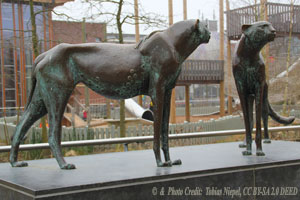
At Amsterdam’s Art Zoo, human visitors stand behind bars while animals appear to roam free. A crocodile hangs overhead; bones rise toward the ceiling and mounted creatures strike theatrical poses. The idea behind the exhibit is to reverse God’s created order: the human spectator becomes the captive animal.
“We really like the concept of having all the people in a cage and then all the animals free,” artist Ferry van Tongeren told The Associated Press.1
Yet their apparent freedom is entirely theatrical. These are not live animals but stuffed preserved ones that are frozen in positions chosen for them by the very human intelligence whose authority the display appears to invert.
The artists describe their work in terms of storytelling and drama rather than opposition to Christianity. Nevertheless, a Catholic critic may ask what the exhibition’s target is. Is this a statement on human cruelty to animals or is it a negation of man’s place in creation? This distinction matters. Dominion over animals carries a duty of care for them. Just because there are abuses does not mean man’s place in the created order is wrong.
Negativism Is Not a Vision
The exhibition denies hierarchy in nature. Such a perspective promotes a nihilistic interpretation of reality. It sends the message that nothing makes a difference since there is no meaning or purpose to life. Man and animal are interchangeable. Order can be overturned without reason. Freedom is arbitrary as it is flipped from one side of the bars to the other.
Hierarchy is not an arbitrary arrangement. Drawing on Saint Thomas Aquinas, Prof. Plinio Corrêa de Oliveira argues that “God, Who imprinted a hierarchical mark on all visible and invisible creation, did the same on the human soul” and that “the diversity of creatures and their hierarchical gradation are good in themselves, for thus the perfections of the Creator shine more resplendently throughout creation.”2
Darwin in a Former Biblical Museum
Taxidermists and designers Jaap Sinke and Ferry van Tongeren credit Charles Darwin as their third artistic collaborator. A series of Darwin busts appears in the exhibition, which occupies a building that formerly housed the Biblical Museum.
For the Christian critic, the setting is full of irony and symbolism: a place once devoted to Scripture now hosts a theatrical inversion of man’s place in relation to animals.
The Curator Keeps His Throne
One authority survives the theatrical revolution untouched: the authority of the artist. Regardless of the artists intentions, the animals’ apparent liberation depends at every point on human intelligence, judgment and control.
The stuffed animals do not determine their positions, choose their gestures or confer meaning upon their display. Humans provide for all these things. The supposed reversal depends entirely on the capacities for judgment, imagination and deliberate arrangement that distinguish its makers from its subjects. The stuffed animals are placed in positions that, if alive, one might eat the other.
The spectacle therefore cannot escape the relationship it appears to invert. It can rearrange the symbols of dominion, but its very existence remains an expression of it.
Revolution Through the Imagination
Like it or not, this inversion has an impact upon the mind. It can shape the imagination toward good or evil.
Prof. Plinio Corrêa de Oliveira, author of Revolution and Counter-Revolution,3 warned that the cultural representations like this one can modify “mentalities, ways of being, artistic expressions and customs without immediately touching directly—at least habitually—ideas.” Through the arts, he wrote, “mentalities can be profoundly influenced and persons, families and peoples can be induced to form a profoundly revolutionary state of spirit.”
Counteracting this disorder requires more than reversing the exhibition’s inversion. Man’s place in creation is not vindicated merely by putting him outside the cage. It is vindicated when he exercises the authority he cannot escape with the responsibility he must not evade.
First published on TFP.org.
Photo Credit: © Tobias Niepel, (CC BY-SA 2.0)