


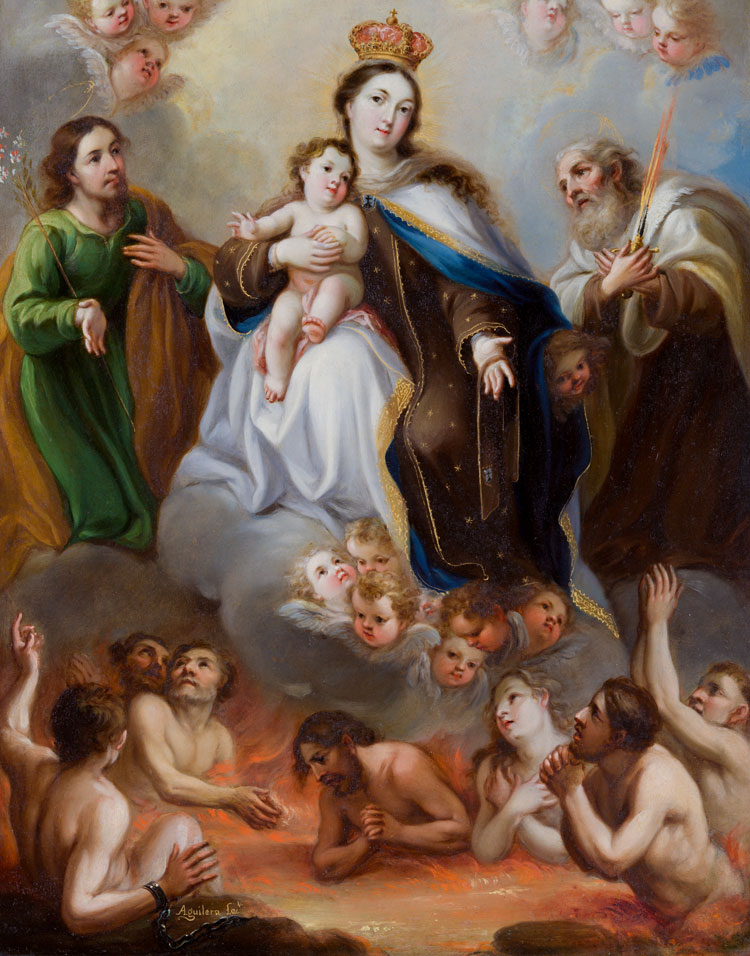
This article is the first part of a series about Purgatory, a topic that is rarely discussed today. A knowledge of Purgatory is essential if souls are to avoid the pains of this place of expiation. The next article can be found here.
* * *
In the magnificent book Purgatory by Father F. X. Schouppe, S.J., the author relates a narrative first told a Father Nieremberg, who Father Schouppe records, passed away “in the odor of sanctity” in 1658.
A Vision
The narrative begins on the Feast of All Saints. While preparing her soul for Holy Mass, a pious young woman saw the apparition of a deceased lady with whom she had been acquainted. Since no one recorded their names, for purposes of clarity, I will refer to the young woman as the girl and the deceased woman as the lady. The lady was dressed entirely in white, including the long veil on her head. She held a long rosary, a sign of tender devotion to Our Blessed Lady. Indeed, when the lady looked upon the Blessed Sacrament, she was so transfixed with joy that the girl said she had never seen anything more beautiful.

The lady explained that, when she was still alive, she had vowed to have three Masses celebrated at the altar of the Blessed Virgin. However, she had not fulfilled that vow before her death.
The narrative does not stipulate the reason, but she had not fulfilled the vow. The lady explained that this failure added to her sufferings in Purgatory.
Two Requests
This lady had been allowed to appear before the girl to make two requests. First, she asked the girl to arrange for the three Masses to be said, including the normal monetary contribution to the parish. Second, she asked the girl to pray for the repose of the lady’s soul so that she could, at last, see the face of God.
The girl did as the lady asked. The Masses had been requested and offered. She had offered fervent prayers for the deceased lady’s soul. The lady reappeared to the girl on December third at the Mass for the Feast of Saint Francis Xavier. Again, while the girl received Her Lord in the Eucharist, the lady remained at her side, looking on with holy enjoyment at the presence of Jesus.
Why America Must Reject Isolationism and Its Dangers
On the Feast of the Immaculate Conception, five days later, the lady reappeared. This time, her face and clothing were so bright that her young friend could not look directly at her. Yet, the lady’s exile in Purgatory continued.
Reception into Heaven
Two days later, the lady made a final appearance to the girl during Holy Mass. Her state was even more wonderful than it had been earlier. She made a profound genuflection before the Tabernacle and thanked her young friend for her assistance. At that point, the lady was released from Purgatory and rose to Heaven in the company of her guardian angel.
Father Schouppe concludes, “It is true that, in this present life, we cannot understand this, because we have too little knowledge of the Sovereign Good for which we are created: but, in the other life, that ineffable Good seems to souls what bread is to a man famished with hunger, or fresh water to one dying with thirst, like health to a sick person tortured by long suffering; it excites the most ardent desires, which torment without being able to satisfy them.”
At least four points can be discerned from this narrative.
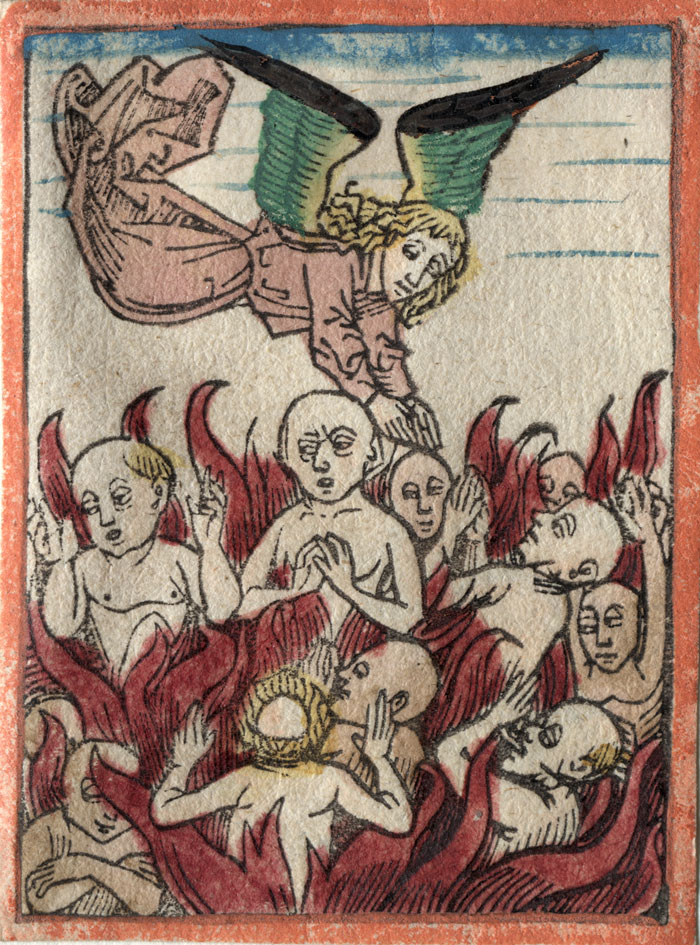
1. Levels of Purgatory.
God’s creation contains many hierarchies. Many seers have recorded that Purgatory has many levels corresponding to the individual soul’s readiness for Heaven. Several saints have had visions of Purgatory and correctly describe it in harrowing words. Many say that it is precisely like Hell in terms of the bodily torments that those in that awful place suffer. Father Schouppe relates many such visions in other parts of this remarkable book. However, in this narrative, the lady is clean, radiant, and clothed in white. Such a description is hardly consistent with those other visions. How can readers rectify the seeming contradiction?
Help Remove Jesus Bath Mat on Amazon
As the narrative stipulates, this lady led a pious life and was devoted to the Blessed Mother. However, she carried sufficient sin to prevent her from entering into the Beatific Vision immediately after death. Nonetheless, she did not deserve the tortures many souls must endure to gain purification. Obviously, she is on a higher plane of Purgatory than others.
2. The greatest pain is the separation from God.
Nonetheless, despite her elevated station, the lady in this story is suffering intensely. Father Schouppe quotes Saint John Chrysostom. “Imagine all the torments of the world, you will not find one equal to the privation of the beatific vision of God.”
Indeed, some say that the worst suffering in Purgatory comes shortly before the soul attains Heaven. Their long suffering is almost, but not quite, over. Exactly when their sufferings will end is unknown to them. With all of the eagerness of a child on Christmas Eve, they anticipate the wonderful things to come. However, unlike the child, no clock tells them when their anticipation will end. All they can do is endure, separated from Him whose presence they most desire.
3. The utter necessity to avoid even the most seemingly minor sin.
It is salutary to realize that, had this lady died in our own time, her friends and relatives would likely express certitude in her immediate reception into Heaven. This author once heard a mistaken Protestant pastor say at a funeral, “When the eye closes in death, it opens in heaven.”
Satanic Christ Porn-blasphemy at Walmart — Sign Petition
This narrative informs readers that the pastor’s assurances were not only incorrect. Indeed, the fact that those nearest the lady being buried believed him likely means that her time in Purgatory will be far longer than it would be if her loved ones accurately knew and prayed for the state of her soul.
Many in this world would regard the lady’s sin in this narrative as slight. All too many might not see it as a sin at all. “Surely,” they might say, “the lady’s vow was a sign of her faith. A loving God will certainly understand this and allow her into Heaven.”
Such errors come from modern misunderstandings of the nature of sin. Every sin is an offence against God. No one can enter God’s perfection unless every sin has been expunged from their souls.
4. The fact that many souls in Purgatory have lived virtuous lives.
Romans, chapter 3, verse 23, reminds everyone, “For all have sinned, and do need the glory of God.” However, many people treat the following verse as a “get out of jail free card.” The passage continues, “being justified by His grace, through the redemption, that is in Christ Jesus.”
How Panera’s Socialist Bread Ruined Company
However, everyone can reject Our Lord’s graces. Grace caused the lady to offer three Masses to Our Lady. However, she then ignored the grace she had received and did not fulfill that Holy vow.
Many people console themselves with the thought that they commit very few sins and that they go to confession and receive absolution. However, many ignore sins of omission and assume that God will ignore them as well.
Sadly, many, like the lady, are tormented because of unkept resolutions or graces to which they did not correspond. However, despite Our Lord’s love for us, His perfect nature cannot simply ignore the sins that everyone has on their souls at death. That is the purpose of suffering, be it some small suffering on earth or the far greater suffering of Purgatory.
To read the next article in this series, please click here.
First published on TFP.org.