


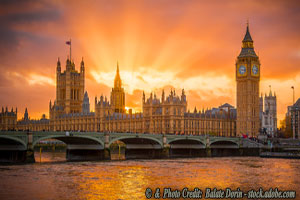
Critics of Augustus Welby Northmore Pugin’s architecture—and even many of his admirers—often refer to his work as “romantic.” They paint him as a kind of refugee from the rapidly industrializing world where he spent his life leading, like Don Quixote, a gallant but fruitless charge into a Gothic past.
Was Pugin a Romantic? The short answer is no. Pugin never treated Gothic (which he called Pointed Christian) architecture as an escape, but rather, as a passage.
The Romantic Movement
In Pugin’s time, the word romantic had a broader meaning than its more sensual connotation today. According to the Encyclopedia Britannica, Romanticism was an artistic movement that “emphasized the individual, the subjective, the irrational, the imaginative, the personal, the spontaneous, the emotional, the visionary, and the transcendental.”
The Romantic movement gained popularity during the early nineteenth century. To many, it represented a form of retreat from the increasing ugliness of the Industrial Revolution.
Romanticism was especially popular in literature. Romantic literary works would include Sir Walter Scott, the novelist who wrote Ivanhoe. The Brontë sisters—authors of Wuthering Heights and Jane Eyre—were prominent romanticists, as were Victor Hugo and Nathaniel Hawthorne. American children were often exposed to Romanticism in books like the popular Little Women by Louisa May Alcott or the Little House books by Laura Ingalls Wilder.
A Snare to be Avoided
Although the Romantic movement is past, the motivations that led people to embrace it remain present. Living life in a romantic haze is a pleasant experience. It is also a trap. In 1992, Brazilian thinker and man of action Prof. Plinio Corrêa de Oliveira warned against falling into it.
“Romanticism was one of the most terrible devices the Revolution devised. Romantic life was the nineteenth century’s typical dream. It’s a world imagined in an entirely artificial way, without any serious consideration, by someone who searches wildly for Heaven as one shouldn’t, continues to search for it, and won’t find it. But at the same time, one is addicted to looking for it and dissatisfied with not finding it, and one keeps banging one’s head against the wall all throughout life until death.”
How many people constantly search for fulfillment by seeking to escape from their lives? They anxiously grab on to anyone or anything who promises to free them from lives they think are intolerable. They look everywhere, except in the direction of God, the one place where they could find true joy.
Professor Corrêa de Oliveira continues, “It’s a dream, a deviation from what we were created for, which is to be inhabited by God. Deep down, the romantic person takes God away and wants to be inhabited by another.”
Pugin’s Scorn for Romanticism
Many modern critics want to classify Pugin as a romanticist. They argue that Pugin’s focus on Gothic architecture was a kind of escapism, a romantic retreat. Many of Pugin’s admirers see him merely as a path to a more beautiful world. In so doing, they entirely miss Pugin’s purpose.
Pugin was not a romantic. For him, Gothic architecture was not an end in and of itself. It was a gate, a channel between this world and Heaven. He wanted to draw people’s attention upward, not so they could admire the beauty of the ceiling but as a way to see beyond the ceiling into the Eternal House of God. Pugin did not see Gothic architecture as an escape but as the beginning of a solution.
Indeed, Pugin had little use for purely romantic Gothic buildings.
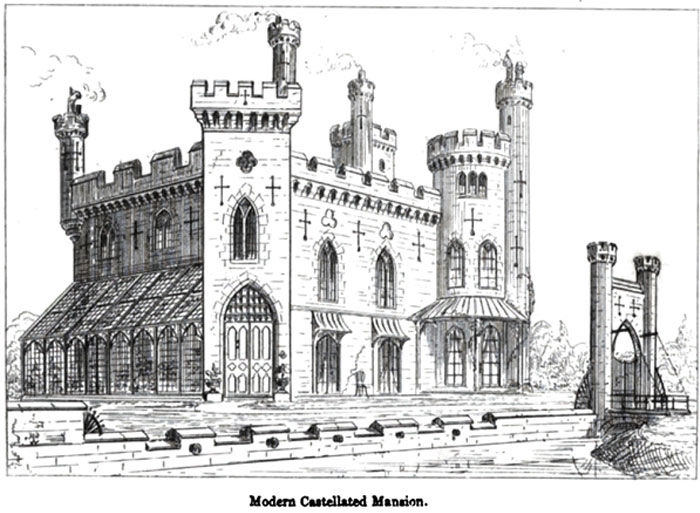
Consider this drawing, which Pugin captioned “Modern Castellated Mansion.” He included it in his An Apology for the Revival of Christian Architecture (1843). Pugin’s evaluation was scathing.
“What can be more absurd than houses built in what is termed the castellated style? Castellated architecture originated [as a] means of defense suited to the military tactics of the day…. Viewed as historical monuments, [castles] are of surprising interest, but as models for our imitation they are worse than useless!… How many portcullises which will not lower down, and drawbridges which will not draw up!… On one side of the house parapets, embrasures, bastions, and all the show of strong defense, and round the corner of the building, a conservatory leading to the principal rooms, through which a whole company of horsemen might penetrate at one smash into the very heart of the mansion! For who would hammer against nailed portals when he could kick his way through the greenhouse?”
The Rood Screen
One characteristic feature that illustrates this portal function is the rood screen found in all of Pugin’s churches.
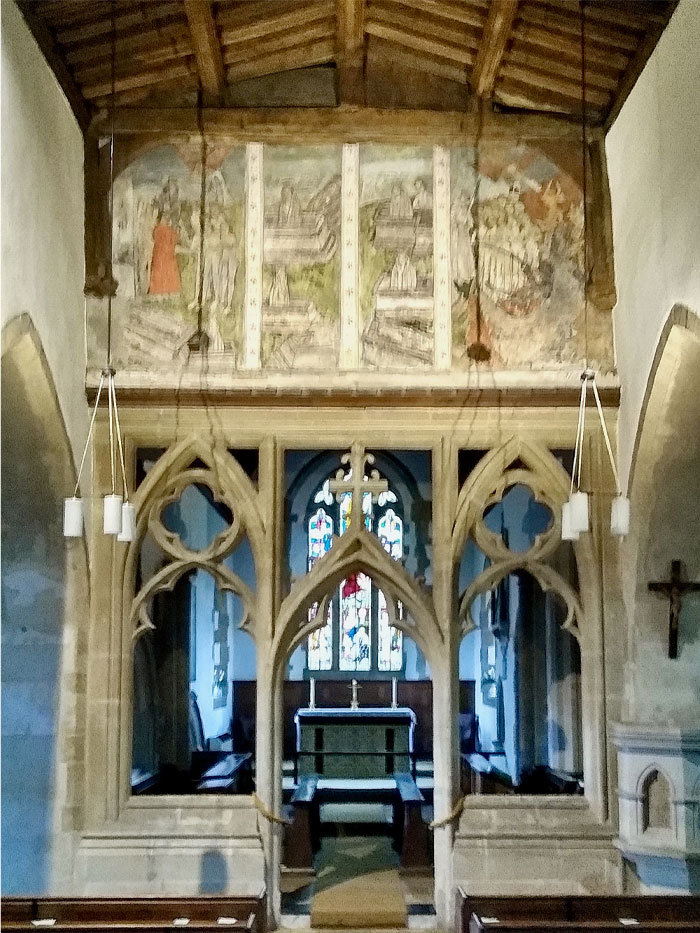
It is a kind of grille between the nave of a church and the sanctuary. Many modern Catholics, even those of traditionalist inclinations, are wrapped in the concept of Holy Mass as an experience for the worshipper. Pugin saw the Holy Mass in a very different light. The rood screen, that ancient English feature, was the gate between this world and Heaven. On one side of it was the sinful mass of humanity. On the other were the mysteries of the Mass and Our Lord deigning to come in His Body, Blood, Soul and Divinity.
Such mysteries are too magnificent for mere humans to appreciate. Only the priest, acting in persona Christi, had sufficient stature to approach and open that Holy of Holies, the tabernacle. Pugin’s screens were controversial, even in his own time. Most have been removed in the spirit of lay participation. However, they remain in Saint Giles, Cheadle, because of the structure’s historic nature and Pugin’s own Church in Ramsgate.
Lasting Importance
If Pugin is not a romantic, what is his legacy?
Indeed, millions who do not know his name attend services in Gothic-style churches in the United States, Great Britain or Australia. They are part of the legacy of A. W. N. Pugin.
However, Pugin’s most critical legacy goes beyond mere style. He actively worked to rebuild Catholicism, specifically Medieval Catholicism. His England was a land in which its government had bitterly fought against the one true Church for centuries. While this treatment was improving as Pugin reached adulthood, it could still only be described as reluctant tolerance. All of the prevailing cultural institutions—government, universities, bureaucracies, the Crown and the long-established prejudices of the people at large—looked down on Catholics.
Pugin ran up the Catholic flag with gusto, vigorously promoted the Church, and worked ceaselessly for its victory. In that, he is an example, indeed an exemplar, for modern Catholics. The skeletal remains of Western Christian society cry out to modern man to embrace that legacy and embellish it for future generations.
Laus Deo!
Photo Credit: © Balate Dorin – stock.adobe.com
First published on TFP.org.