


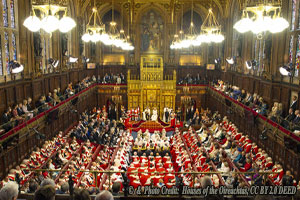
When the current session of the British Parliament ends this spring, the nation will abruptly bring to a close a 700-year institution. On March 10, the House of Commons voted to abolish the hereditary lords in the House of Lords.
The effort ends a process started in 1999 by then-Prime Minister Tony Blair. His Labour government reduced the number of hereditary lords from 750 to 92. Now, even these remnants of an ancient order must go in the name of a radical egalitarian ideal.
When King Charles gives his royal assent to the bill, the lords will bid adieu to Parliament and fade away. Their pomp and pageantry, that so enchanted the world, will not be returning. Something of England will have died.
Origins and History
Hereditary lords are those House of Lords members who inherit the right to sit in the upper house based on past services their families rendered to the realm. Many storied families have retained this right in their lineage for generations. Over the centuries, they have passed on their experience to their successors.
The House of Lords originated in the eleventh century, as a council of religious and temporal leaders which the king convoked to fulfill the difficult duty of rendering “counsel and aid” to their sovereign. It later developed into a more formal government institution in the thirteenth century.
In the nineteen fifties, Parliament created “life peers,” who are appointed by prime ministers to serve for life. Many have criticized these appointments as party cronies who receive the office as a political favor or because of donations to the party. They do not need to form a legacy that projects into the future.
The House of Lords has no legislative power but exercises an advisory role, correcting legislation from the House of Commons based on its members’ experience. The upper parliamentary chamber can slow down populist passions by delaying passage, proposing amendments or taking other deliberative measures.
An Egalitarian Agenda
The determined move to abolish the hereditary lords is part of an egalitarian agenda to rid the nation of this institution, which leftists deem “anti-democratic.”
Parliament’s upper chamber will now be changed into something like a modern senate composed almost entirely of life peers. However, this “democratic” makeover still consists of unelected appointees. The more radically egalitarian leftists would like to see even these appointees abolished and an elected chamber installed.
The Nation’s Ablest Leaders
Britain has everything to lose with the abolition of the hereditary lords. The legislative process will be deprived of some of the nation’s ablest leaders who excel in their leadership, business success and social brilliance.
Unlike the House of Commons, the lords are not salaried and can only claim minimal reimbursement for their expenses. They are required by law to offer counsel freely to the realm, as they have, from time immemorial.
Finally, hereditary lords take their tasks much more seriously since they must uphold their family names over generations. Since attendance is not obligatory, life peers often do not bother to attend when Parliament is in session, yet still benefit from the prestige of the appointment.
An Ideological Agenda
The left’s vicious attacks on the lords make no sense. Advice from highly qualified, well-connected individuals at little cost to the public purse clearly benefits the common good. The nation has everything to gain by accepting these nearly free consultants, whose fame extends worldwide by their colorful pageantry and history.
The real reason for abolishing the hereditary lords is the left’s egalitarian ideology. The left rejects any expression of inequality, especially when splendrously manifested as do the lords. The upper house’s beautiful traditions and customs speak of a Christian social order that attracts the English masses. The left must further level the distinctions and privileges that recognize and reward excellence, drawing on a past that projects into the future.
The hereditary lords represent a lost beauty that lingers from an ancient past associated with England. Their noble manners, magnificent robes and legendary names evoke a fairy-tale innocence that dazzles all with wonder and awe.
Thus, abolishing the hereditary lords takes away something from the English soul. Something intangible will be lost, and it can never be recovered.
When Merrie England Was Merrie
Pope Saint Gregory the Great sent Saint Augustine of Canterbury to bring the Catholic Faith to the fair people called Angles who inhabited Britain. According to Venerable Bede, he said “Non Angli, sed angeli si forent Christiani,” which means “Not Angles, but angels if they were Christians.”
The evangelization of these Anglo-Saxons gave rise to Merrie England and the flourishing of the Faith and society.
The joy of the Catholic Church faded with Henry VIII’s plundering of the monasteries, the rise of Protestantism and Puritanism, and later the economic upheaval of the Industrial Revolution. Alas, England was Merrie no longer.
The End of England?
The loss of the hereditary lords in Parliament is part of this process of self-destruction. The lords are part of the mythical bulwark that sustains England.
It will eventually lead to the end of the British afternoon tea, pubs, cricket, English gardens, and so many other popular manifestations of what it means to be English. What replaces this vision of England is a cosmopolitan mixture of global cultures that express no values but only gratification and pleasure.
***
The left reduces all to the basest materialism and a class struggle narrative. It seeks to make everything devoid of pomp and circumstance. Destroying such splendor is tragic because it touches on something special in the English soul that resonates in the American one, and which must not be allowed to die.
England must be Christian again. Then she will be merrie and be inhabited by angels.
Photo Credit: © Houses of the Oireachtas, CC BY 2.0
First published on TFP.org.