

Mayor Zohran Mamdani’s housing policies clearly reflect his “democratic” socialist approach. He focuses on rent freezes, tenant protections, and strict code enforcement, which he claims will help “everyday New Yorkers” escape the city’s housing crisis.
He doesn’t mention how intrusive government regulations have largely contributed to the current crisis. The government is the defender of people’s rights. The tenant is always the victim. Any problem is the landlord’s fault!
Yet, in a surprising twist of irony, he is pursuing policies that are quietly pushing the traditional, family-owned “mom-and-pop” landlords to extinction. Mayor Mamdani is holding “Rip Off” hearings, orchestrated to shift blame for the city’s housing crisis onto landlords, especially corporate or large landlords. However, the regulations he proposes will create conditions that will squeeze out the small landlord and favor large landlords, who will be the only ones who can afford to implement them.
A Landscape of Empty Promises and Empty Apartments
The housing crisis can be attributed to the 2019 Housing Stability and Tenant Protection Act (HSTPA). This law removed landlords’ vacancy bonuses and limited their ability to recover maintenance costs. The result was a disaster in socialist urban planning, with the rental properties experiencing a sharp increase in deferred maintenance.
Ann Korchak, president of the Small Property Owners of New York (SPONY), highlights a troubling statistic: more than 50,000 apartments are currently vacant. The reason is that the cost to upgrade them after a tenant leaves far outweighs the potential rental income. Thus, roughly five percent of the city’s rent-stabilized housing stock is off the market and gathering dust amid a historic housing shortage.
Drowning in Debt
One big problem is rent stabilization rules, which stipulate that landlords can only raise rent by specific, typically low, percentages set by local boards.
For 100 percent rent-stabilized buildings, the outlook is bleak. According to Columbia Business School, models show that a four-year rent freeze would cause a deep decline in net operating income that a property owner could never fully recover costs. If expenses keep rising by 5 percent annually, while rents stay frozen, these buildings become completely unprofitable in no more than 17 years.
This financial burden is further worsened by a frozen credit market. After the 2019 rent laws, and the sharp increase in interest rates in 2022, property values plummeted. Lenders understandably pulled back.
From 2019 to 2025, lending to the city’s rent-stabilized properties dropped by an astonishing 74 percent. Today, many owners in boroughs like the Bronx discover that their properties have zero—or even negative—equity. Their lifelong retirement savings have been wiped out by socialist mandates.
The Human Cost of a Spreadsheet Reality
Consider the Grimaldi family. Giovanni Grimaldi’s father immigrated from Sicily in 1972 and purchased a 55-unit rent-stabilized building in the Bronx. For decades, owning a handful of units was a reliable, middle-class business. It was a symbiotic relationship: Landlords lived in and maintained the buildings, and tenants paid a fair, inflation-adjusted rent.
Today, the Grimaldis’ buildings haven’t turned a profit in years. With capped rents, soaring mortgage rates, and rising maintenance costs, the family is barely staying afloat. Now, facing Mamdani’s proposals to freeze rents while also increasing property taxes by 9.5 percent, many families like the Grimaldis are simply giving up and selling, or worse, walking away from their properties. “Tax the rich” is a slogan that fits smartly on a protest sign, but collapses under the weight of reality.
Giving up on rental properties can be very emotional for these mom-and-pop operations. Family landlords often live in the same buildings as their tenants. They attend the same block parties; they know when a tenant loses a job or goes through a personal tragedy. There is a very human give-and-take that simply does not exist when a tenant is just a line item in a corporate portfolio.
The Corporate Takeover
As small landlords struggle under the weight of destructive socialist policies, who steps in to take over? National multifamily operators and well-funded real estate investment trusts are the only ones that can afford to do so.
In the early 2000s, property sales between corporate owners and individuals were about equal. Today, corporations are purchasing nearly four times as many properties from individuals as individuals are purchasing from corporations.
The “tenant-friendly movement” is hurting the tenant. A study by the New York University Furman Center shows that corporate landlords evict tenants 50 percent more often and increase rents by an average of 3 percent after buying properties, compared to non-corporate landlords of the same buildings.
Independent landlords running small, family-run operations tend to view their tenants as actual human beings. This necessary human element is rapidly evaporating from the skyline: today, massive corporate entities control a staggering 90.2 percent of New York City’s multifamily housing stock, leaving individuals to cling to a meager 9.8 percent.
For deep-pocketed investors, the shrinking minority of independent owners presents a highly lucrative opportunity. They circle these distressed, family-owned properties, eager to snatch up prime real estate at bargain prices. When the seller is a small family operation struggling to stay afloat, they simply lack the leverage to fight off a corporate giant’s aggressive offer.
It is no secret that New York City’s housing market is deeply flawed. The crisis is made worse by virtue-signaling, misguided policies and ideological posturing. Under the guise of progressive reform, politicians like Zohran Mamdani are effectively regulating the last remaining “mom and pop” apartment owners out of existence into the hands of well-heeled corporations.
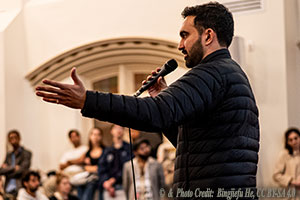
Photo Credit: © Bingjiefu He, CC BY-SA 4.0
First published on TFP.org.