


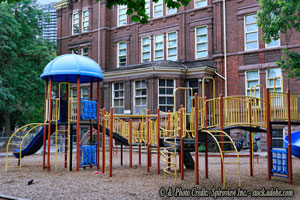
On April 22, 2026, Governor Kevin Stitt of Oklahoma signed Senate Bill 1481, requiring that all elementary school students (grades kindergarten through five) receive at least forty minutes of recess daily over and above the amount of time they spend in Physical Education. The new law has two other requirements. “Recess shall consist of supervised, unstructured time for play,” and “No student shall be prohibited from participating in recess as a form of discipline.” The new law goes into effect in August.
That law is part of a trend toward reviving school recess. Several states have either passed laws similar to the Oklahoma statute or are considering it seriously. This swing reverses a trend that began as an attempt to meet the requirements of the “No Child Left Behind” and “Common Core” programs. More rigid school schedules virtually eliminated the idea that students should get such breaks.
Anti-Recess Theories
Educators didn’t make that earlier move mindlessly. Four primary reasons stood behind it.
The most important thing was to clear time for more academic instruction, especially in math and reading. This was a sort of “knee-jerk” reaction to declining test scores in those subjects. More time spent on those skills, the theorists reasoned, would help scores improve.
The second reason for eliminating recess had to do with student discipline. A 2012 article in Education Week summed up the situation. “It is often the place where [principals] receive the most discipline referrals because kids do not always know how to play well with one another.… ‘Principals report that the majority of discipline-related problems occur outside of class time (87%) with the majority of those occurring during recess or lunch (89%).’” (Emphasis in the original.)
The third reason concerned faculty supervision. Keeping track of several hundred students employed in various activities in a large area, even if the area is enclosed, is a difficult task for teachers. Responsible supervision requires almost constant motion, and the possibility that unsafe activities can take place in two separate parts of the playground simultaneously stretches even the most scrupulous teacher’s ability.
The last reason also pertained to student safety, but in this case, the argument focused primarily on schools in impoverished urban areas. Many such schools lack sufficient play spaces or equipment. Under such conditions, students often sneak away from the school and potentially fall prey to unsafe or unhealthy conditions in the surrounding streets.
The Gathering Weight of Experience
Even when administrators eliminated recess, though, the chorus in its favor was strong. Students, especially those with mental difficulties or behavioral issues, reacted badly to increased confinement. Parents, who had enjoyed recess during their childhoods, had a hard time imagining how difficult their children’s days would be without a little time to “let off steam.” Some teachers also noticed that the increasingly rigid school day hurt student achievement, as even the best students reached the end of their attention spans.
However, the educational bureaucrats who opposed recess often dismissed such concerns as “anecdotal.” Certain that the bulk of evidence was on their side, they continued down their rigid path.
Scientific Evidence
However, it did not take long for contrary evidence to accumulate. In January, 2013, the American Academy of Pediatrics (AAP) published a study titled “The Critical Role of Recess in School.” Unlike many such documents, the study’s very first paragraph made the AAP’s position crystal clear.
“Recess is at the heart of a vigorous debate…. A growing trend toward reallocating time in school to accentuate the more academic subjects has put this important facet of a child’s school day at risk.… [S]afe and well-supervised recess offers cognitive, social, emotional, and physical benefits that may not be fully appreciated.… The American Academy of Pediatrics believes that recess is a crucial and necessary component of a child’s development.”
Nor, amazingly, did the AAP see any reason to revise its work over time. In April 2023, it simply “reaffirmed” its ten-year-old article.
The Growing Brain
A March 26, 2026, article in Science Insights provided important details indicating that recess plays a critical role in a child’s developing brain.
“The prefrontal cortex… is actively recruited during tasks like impulse control, switching between activities, and holding information in working memory. Children who regularly practice these skills through self-directed play appear to develop more efficient neural pathways, meaning their brains accomplish the same cognitive tasks with less effort over time. Structured classroom learning… can work against this process…. Prolonged cognitive strain raises cortisol, a stress hormone that inhibits learning and memory. A well-timed break literally lets the brain recover.”
This point only stands to reason. Most, perhaps all, adults have found that their ability to complete a difficult task improved by taking a break. Focusing on something more pleasant while the “back of the mind” chews on the best way to complete the work at hand is effective in almost any setting.
Given the weight of scientific evidence and plain old common sense supporting school recess, it is difficult to imagine how or why the controversy persisted for so long. Certainly, as with all aspects of raising children, recess has its issues, but those are for the adults to figure out. The educational theories of 2005 must now bow before the well-known facts—recess works!
Photo Credit: © Spiroview Inc. – stock.adobe.com
First Published on TFP.org