


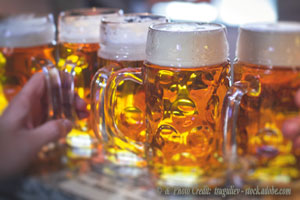
Serving a beer without foam is a mild tragedy, akin to handing someone an espresso stripped of its crema. Not everyone understands why suds matter.
In fact, many drinkers view foam as an enemy—a cynical trick bartenders use to shortchange them on the actual liquid. Yet this fluffy, protein-rich network of bubbles is the unsung hero of the brewing world and a product of Christian civilization.
Good foam is an intricate bubbly crown with a purpose. A stable, creamy head is the clearest sign of high quality. It shows that the carbonation is precise, the glassware is pristine, the brewing process was balanced, and the bartender cares about his craft.
Rather than shorting the customer some of the beer, foam informs the experience. It dictates how the nose perceives the aroma, shapes the mouthfeel and bravely sacrifices itself to protect the beer from losing those precious aromatic hops to evaporation and oxygen’s rapid, flavor-dulling effects. In places like the Czech Republic, foam is treated with near-religious reverence—as a symbol of freshness and deep respect for the beverage itself.
The Science of the Suds
Foam is a delicate balance of chemistry and physics. A truly stable foam head features tiny, uniform bubbles with a stubborn elasticity that resists collapsing too quickly. Brewers measure this resilience with a Foam Stability Test, monitoring how long it takes for the head to surrender to gravity.
For the person holding the pint, this science should translate into pure sensory pleasure. Stable foam traps delicate aromas, softens the sharp bite of carbonation, and creates a silky texture on the palate. Without it, beer can quickly turn into a lifeless, flat disappointment.
The great enemies of this delicate arrangement are shockingly mundane: a speck of grease, detergent residue or even a smudge of lipstick on the glass’s rim. These hidden villains disrupt the stabilizing layer around the bubbles, causing the foam to die in a rapid, fizzling death.
A Tale of Two Foams: Wet vs. Dry
Nothing in creation is equal, including foam. The moisture content of foam determines the quality of your drinking experience.
The Beauty of Wet Foam
Wet foam is dense, remarkably creamy and effortlessly drinkable. Packed with microscopic bubbles, it feels less like a dry cap awkwardly perched on top of the beer and more like a pillowy extension of the beer itself. Poured correctly—often via traditional side-pull taps—wet foam softens the carbonation, preserves the aroma and coats the tongue with a luxurious, rounded texture.
The Harsh Reality of Dry Foam
Conversely, dry foam is a structural failure. Airy, fragile, and composed of large, unstable bubbles, it usually forms when a beer is poured too aggressively or is overly carbonated. Dry foam collapses quickly, offering no protection to the beer beneath and no welcoming introduction to the beverage below. On the palate, it tastes harsh and bitter, entirely disconnected from the liquid you actually want to taste.
The Art of the Pour and the Vessel
The humble glass serves as the canvas on which this liquid masterpiece is painted. Microscopic scratches or even the faintest trace of unrinsed soap can instantly destroy a perfectly good head of foam. Temperature matters, too. While a chilled glass helps stabilize the head, a frosted glass introduces ice crystals that trigger aggressive over-foaming and mute the beer’s aroma.
Ultimately, creating the perfect foam is an act of hospitality, which is a fruit of Christian civilization. It is a sign of Christian excellence that does things to perfection, especially those aimed at pleasing one’s neighbor. Many European pubs treat the pour as a sacred craft. Bartenders manipulate the flow, density and carbonation released to craft that perfect, creamy wet foam. Many beers are intentionally brewed with soft water, specialized hops and a long cold maturation process to ensure they pour beautifully.
Embrace the Foam
Foam is not a superficial afterthought; it is the breathtaking union where the fruits of Christian Civilization, such as fluid dynamics and human hospitality, intersect in a single glass. Understanding the delicate interplay among proteins, carbon dioxide and pouring techniques transforms a simple drink into a sensory delight.
The next time a bartender slides a heavily crowned pint down the bar, don’t sigh at the “lost” liquid. Take a moment to admire the architecture of the bubbles. Marvel at the aroma they release and savor the silky texture that pleases the palate. Great beer demands great foam, and beer drinkers deserve nothing less.
Photo Credit: © tsuguliev – stock.adobe.com
First Published on TFP.org