


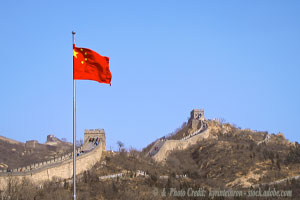
Some people think that the international rivalry between the United States and China will develop into a second Cold War.
Indeed, the U.S.-China relationship is becoming a fierce rivalry across every front. There is a clash of ideas, a heated economic competition and a growing military race for dominance.
However, this narrative rests on a false premise: that China is a superpower like the United States. Whatever else it may be, China is simply not a superpower—and has little prospect of becoming one.
China Is, Without Question, a Big Power
China is undoubtedly more than just another player on the world stage. It might be called a “big power,” not a superpower. It gained this status through decades of rule-breaking, import restrictions and intellectual property theft. China benefited from a massive influx of Western capital, technology and expertise. It is willing to leverage its position to project power worldwide.
What Beijing commands:
- A modern and growing nuclear arsenal.
- An impressive fleet of satellites, including 229 intelligence, surveillance and reconnaissance satellites.
- The world’s largest navy by number of vessels.
- Potent cyber capabilities.
- Economic clout few nations can match.
What Actually Makes a Superpower
All these advantages define a big power. However, China is definitely not a superpower.
A superpower means more than having large economic and military resources. Important cultural, historical and diplomatic elements give its actions clout and influence. A real superpower needs sufficient military, economic and cultural strength to do two things: influence events around the world and shape international rules in its own favor.
This is what sets superpowers apart from merely powerful countries. Big powers matter, but superpowers do more than play a role on the world stage—they possess every kind of power needed to dominate and shape global events.
Where China Falls Short
However, China falls well short of this mark. It may dominate its home region economically and exert considerable economic influence worldwide. But consider what it lacks:
- Limited military reach. China cannot project serious military power beyond its immediate neighborhood.
- Local allies. China has exactly one local military ally, North Korea. Meanwhile, nations across the Indo-Pacific are actively working to defend themselves against China, both diplomatically and militarily.
- Almost no soft power. A closed, authoritarian system produces little of the cultural appeal that draws others willingly into its orbit. Its strong-arm tactics in its business deals invite little sympathy.
- No global alliance network. Unlike the U.S., China sits at the center of no genuine worldwide alliance system.
- A junior role in global institutions. In the international institutional space, China remains more of a follower than a leader.
While China stands as a powerful force in its region, it falls substantially short of true superpower status.
Why the Communist System Caps China’s Rise
China’s shortfall is not temporary or accidental—it stems directly from the nature of its one-party communist regime. The very features that keep the Party in power are the same ones that prevent China from achieving superpower status. In other words, China is not powerful due to communism. It is weak because of it.
Superpowers attract; they do not merely coerce. America’s global influence has long rested in part on the appeal of its ideas, culture and institutions—what Harvard’s Joseph Nye famously called “soft power.”
A regime that spies on and censors its own people, jails dissidents and demands ideological conformity has very little to offer the world in terms of attraction. Fear can force compliance, but it can never buy genuine adhesion. A system that silences its own citizens does nothing to attract investment, talent and immigration.
Centralized Control Breeds Economic Fragility
State direction of the economy may deliver impressive results for a time, but it eventually eliminates incentives, misallocates capital and smothers the innovation that sustains long-term growth. China is now showing the classic symptoms of the “middle-income trap”—the point at which fast-developing economies stall before reaching the prosperity of the developed world.
Both the International Monetary Fund and the World Bank have flagged the economic malaise caused by inefficient state-owned enterprises and a mounting national debt. The Communist Party cannot loosen its grip on the economy without loosening its grip on power, and so it stifles the very dynamism it needs to keep rising.
A Party That Fears Its Own People More Than Its Rivals
A regime that pours enormous resources into internal surveillance and control has that much less to spend on projecting power abroad. China’s domestic security budget has, in some years, exceeded its official military budget—a telling sign of where the leadership’s deepest anxieties lie. A superpower looks outward with confidence. China looks inward with suspicion.
Put plainly, the communist system is not the engine of China’s strength. It is the ceiling on its ambitions. Every instrument the Party uses to secure its rule—censorship, central control, surveillance—is also the cause that quietly hollows out the country’s capacity to lead the world.
The Danger of Believing the Illusion
If China is not a superpower, American policy should adapt to this reality. It should exploit China’s weaknesses and leverage America’s strengths and alliances. China poses a great danger to America worldwide, but its threat must be put in perspective.
What the United States actually faces is a big power with obvious pretensions of becoming something greater, but without realistic prospects of achieving them. A responsible and restrained American strategy would focus squarely on that challenge. The loudest cheerleader for China’s superpower status is China’s leader, Xi Jinping. He has orchestrated a brilliant propaganda campaign extolling China’s status that Western media, politicians and naïve business leaders have accepted at face value. It is time to stop overestimating China’s strength and underestimating Xi’s fears.
Photo Credit: © kyrintethron – stock.adobe.com
First Published on TFP.org