


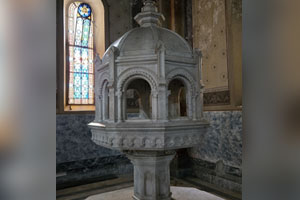
The steady rise in adult Catholic converts across the West over the past five years has made headlines and given hope to the faithful. Nowhere has this caused a bigger stir than in France, the first-born daughter of the Church.
Naturally, most of the attention has been on the numbers. According to the French Bishops’ Conference, adult and adolescent converts to Catholicism remained steady at between 4-5,000 per year since the beginning of the twenty-first century. Then shortly after Covid, those numbers began to rise steadily, reaching 5,825 in 2022, 8,416 in 2023, 12,340 in 2024, 17,788 in 2025, and finally 21,386 at Easter 2026—a stunning 400% increase.
Although impressive, these converts are still dwarfed by the massive numbers of those who leave the Church. The percentage of French people who identified as Catholics fell from more than 90% in the sixties to just 30% today. In the seventies, more than three-fourths of French babies were baptized in the Catholic Church, compared to 50% in 1996 and just 25% in 2024. Similar declines can be found in the other sacraments, such as marriage, Confirmation, and First Holy Communion.
Nonetheless, this wave of conversions is undoubtedly one of the most extraordinary religious trends of our time, or indeed, of any time. It is not an exaggeration to call it miraculous, a clear sign of the grace of God acting in His Church at a time of unprecedented crisis. It simply “shouldn’t” be happening at all, according to the logic of modernity.
Take a deeper look at the motivations and spirituality of these conversions, and the trend gets even more interesting. Earlier this year, the French Bishops’ Conference published a survey of 1,450 catechumens across 60 (out of 100) French dioceses. It found that 58% of 2026 converts are women and 42% are men. They are also very young, with 80% under 40, and they are spread fairly evenly across the country, in both rural areas and large cities. All social classes are fairly evenly represented, from the working classes to the professional middle and upper classes.
The survey asked the following question: “What was the main reason why you asked for baptism?” The most popular response (40%) was “I experienced a hardship (illness, funeral, etc.) that began a search for meaning.” This was followed by “I began to ask questions about the Catholic religion” (34%), “I had a strong spiritual experience” (32%), and “I visited a religious place and was touched by its beauty” (23%).
Surprisingly low on the list was direct apostolate of another person, such as the “Christian witness of a friend or family member” (19%), “Someone close to me requested baptism” (16%), or “I followed influencers on social media” (11%). Any conversion requires above all the grace of the Holy Spirit. But conversions to the Catholic Faith—especially on a large scale—have almost always happened through human means, such as through missionary priests doing direct apostolate with the people.
The wave of conversions has taken place with virtually no direct role of the French clergy. The Holy Spirit, it seems, is acting in souls outside the traditional human channels. The clergy, for their part, have been quick to admit that they had very little to do with attracting these converts. The report’s author, Archbishop Olivier de Germay of Lyon, explained, “ This phenomenon continues to amaze us because we don’t claim to have a single answer to explain it… Many young people tell me they have felt an ‘inner calling’ or had a powerful ‘spiritual experience,’ an unexpected ‘encounter with God.’ It’s as if technological progress hasn’t lived up to its promises. It creates an inner void and leads to a great deal of dissatisfaction.”
This deep dissatisfaction with the false promises of modernity is a common thread that runs through these conversions. The catechumens have a spiritual thirst for Catholicism, he believes, because the Catholic Faith is no longer as taboo as it once was. Young people who have been raised without any religious education whatsoever will knock on the rectory doors with an open mind and without prejudice. He believes they are looking for “an identity that isn’t identitarian” and sees the Church as “a solid institution with deep roots that someone can rely on.”
Many describe this trend as a search for meaning among a youth that is completely unmoored. Generation Z, with its high rates of depression and anxiety, is particularly attracted to the Catholic Church’s 2,000-year history, traditions, and doctrines. Archbishop Eric de Moulins-Beaufort of Reims observed that “the catechumens describe their past lives as filled with sadness, a sense of emptiness, and a suffocating anxiety. Once they have encountered Jesus, discovered the infinite love with which they were loved…they discover a deep inner peace that reconciles them with the most beautiful aspects of their lives. They attribute the best of their experiences to Jesus, as if He had always guided and accompanied them.”
Charles Mercier, professor of contemporary history at the University of Bordeaux, observes that until about 20 years ago, new converts would generally join more charismatic movements inside the Church. Today, they tend to be much more conservative, even traditionalist, with “an appreciation for liturgy and a fairly firm adherence to orthodox doctrine.”
These young people are seeking out not just solid doctrine and liturgy, but also a more traditional spirituality. Since the sixties, progressives in the Catholic Church have tried to dismiss traditional Catholic spiritual practices and replace them with a more “social” Catholicism. In France, figures such as Cardinal Achille Liénart, Archbishop of Lille (the so-called “red” cardinal), or Bishop Jacques Gaillot, Bishop of Évreux, represented this modernist current. France was also the center of several progressivist currents, such as Le Sillon and the Worker Priest movement, which sought to suppress traditional Catholic spirituality.
“Among young people who joined the Catholic Church as adults, as well as those who grew up Catholic, we’re seeing a resurgence of traditional devotions—such as the rosary—that had been somewhat sidelined by previous generations,” Mercier explained in an interview. “This new generation is reclaiming practices that were once seen as old-fashioned or outdated, while sometimes adapting them… One example is the Sacred Heart, which was the subject of a film and has also become a decorative item, available at major retail chains.”
Pope Francis spent his pontificate appealing to progressive causes, such as ecology, mass immigration, and Communion for divorced and civilly remarried Catholics. Generation Z, however, is attracted to processions, pilgrimages, incense, Latin, and Gregorian chant. They are much more likely to receive Holy Communion on the tongue, kneel during much of the Mass, or wear a chapel veil, practices that were discouraged after Vatican II.
The annual Paris-Chartres Latin Mass Pilgrimage over Pentecost Sunday, for example, has grown from just a few thousand pilgrims in the nineties to more than 20,000 in 2026, with the great majority under 30. Veneration of relics is also increasing. The number of pilgrims to the Holy Tunic of Argenteuil near Paris grew from 200,000 in 2016 to nearly half a million in 2025.
Converts often attribute the fond memory of a parent or grandparent as a major factor in their return to the Faith. Many recall how their grandmother would faithfully take them to church, teach them how to pray, and serve as a model of Christian goodness and love in the family. Or a grandfather who made a pilgrimage to Lourdes and led the family prayers every night.
Guillaume Cuchet, professor of history at the Sorbonne and author of La Religion des morts (The Religion of the Dead), points out that following a traumatic life event—such as the death of a loved one—a non-believer is forced to confront the deeper questions and the purpose of life. Many find that the modern world does not give satisfactory answers. Although fewer than 5% of French people attend Mass every Sunday, 70% choose a Christian burial. In times of illness, suffering, and especially death, people turn to religion, which is a big opportunity for the Church to evangelize.
The search for roots, meaning, community, and identity in Catholicism has another cause: the growing Islamization of France. Muslims make up around 10% of the population and are growing rapidly. In cities with large Muslim populations, native French people are confronted every day with calls to Islamic prayer in the streets, women wearing the hijab, sexual assaults on French women, and even informal prohibitions on the sale of pork. French society and culture are being threatened with total destruction by a foreign, communitarian religion. Secularism, materialism, and hyper-individualism are simply unable to resist a religion that emphasizes group identity, doctrinal certainty and unquestioning submission. Many fallen-away Christians are looking for a response and are finding it in France’s ancient faith, Catholicism.
As a result, the nature of French Catholicism is changing. For the past century, French Catholics have mostly retreated from public life in the name of laïcité. Now, these young converts are proud of their faith and more and more likely to share it in public. “It’s fascinating,” said Father Benoist de Sinety, a parish priest from Lille, describing this year’s Ash Wednesday service. “In my day, we would rush to wipe away the cross we’d made on our foreheads as soon as we stepped outside so as not to draw attention to ourselves; today, young people flaunt it, take selfies, and keep it there all day long.” The faithful and especially the young people, he said, are eager to show that they were indeed at Mass that day.
It remains to be seen how durable this trend will be. Nevertheless, it is already having major effects on the French religious landscape and changing the way French Catholics see themselves and their place in society. Bishop Matthieu Rougé of Nanterre sums up the situation: “We are moving from a predominantly Catholic France to a France characterized by a significant Catholic minority.” As the persecution of French Catholics continues to grow, from both Islam and the far-left secularists, the fervor of France’s Catholics will certainly grow as well. These new converts will have to contend with a Church that has been in a deep crisis for generations. Yet God has not abandoned the Church, nor its first-born daughter, France. He continues to act upon souls, and Catholics have many reasons to hope that this action will only increase.
First Published on TFP.org