


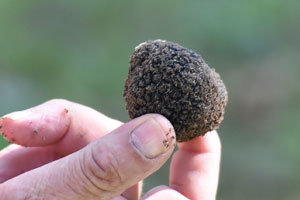
There is no crop in France quite like the truffle. Wheat has been sown for five thousand years; the black truffle has been deliberately cultivated for barely two centuries. 1 Yet in those two centuries, growers have never managed what farmers do with almost every other crop they plant: guarantee a harvest.
French farmers must rely on God and tradition to produce truffles. It is not a typical crop that can be industrialized.
Indeed, a truffle farmer can prepare the soil, inoculate the roots, irrigate during drought, and then wait a decade—and the earth may still yield nothing. Agriculture and science have not been able to ensure a consistent crop, but families who harvest truffles have learned the trade’s secrets and kept truffles on the market.
Familial tradition kept French truffle farming alive in three distinct ways. Family dynasties preserved the physical farms (truffières) and oak plantations amid wars and rural flight. The transmission of embodied, sensory know-how that no manual could replace; and a cultural attachment to family traditions that discovered technique and kept replanting oaks as an act of legacy rather than for short-term profit. One can say it is a fruit of Christian civilization.
A Peasant’s Accident
Truffles were eaten long before anyone tried to cultivate them. Farmers dug them from the wild using pigs and dogs to find them. They seemed to appear wherever they wished. No one quite understood their mysterious origins. The turning point came in 1808 in the hills of Provence, when Joseph Talon, a peasant farmer from Saint-Saturnin-lès-Apt, noticed that areas around oak trees also produced truffles.
He gathered their acorns, sowed them and years later found truffles in the soil around his new oaks.2 Talon is remembered as the father of modern trufficulture (truffle farming)—though he never understood why it worked. He was reproducing an effect he could see but not explain, a pattern that still defines the craft.
Even With Advanced Science, Raising Truffles Is Still a Gamble
Modern science has uncovered part of the answer, but in doing so has only deepened the mystery. For a long time, truffles were assumed to reproduce on their own. Around 2010, sequencing the Tuber melanosporum genome revealed that the black truffle is heterothallic, meaning it has two mating types and can form only when opposite strains meet.3
The trouble is that on any given tree, one type tends to dominate and crowd out the other, leaving the required partner absent. Researchers call this a “Romeo and Juliet” problem of space and time, and it partly explains why truffle production often declines as orchards age.4
To a great extent, yields hinge on summer rainfall from the year prior to harvest. Only about a quarter of planted oaks ever produce, and that is only after six to ten years have passed. It’s no wonder growers say a good year for wine is a bad year for truffles.
God’s Grace, Tradition and Intuition
Truffle farmers know they depend entirely on God’s grace above all else because so much lies beyond human control. French truffle culture is interwoven with familial traditions and intuition. Old hands claimed to detect a truffle’s presence from the lay of the land alone. The fungus betrays itself in the brûlé—a scorched patch of bare earth where it has starved out competing plants—and in a particular fly that lays its eggs above ripening truffles.
Hunters swear the biggest harvest comes after a full moon and that the hunt goes best in late morning, once the dew has burned off. Pigs were the traditional hunters—but they want to eat the prize, so Labradors, even mutts, “calm, gourmands attached to their master,” have largely replaced them.
The Family Secret
The trade is, above all, inherited and secret. In Sorges, France, in the Périgord region, truffle knowledge has been passed down through the same families for more than two centuries. Truffle prices are set once a year by the leading farmers in Provence. There, at the Saturday winter market in Richerenches—held near a former Templar commandery—the ceremonial heart of the trade is where deals are struck with nods, whispers and cash (no PayPal or Venmo accepted).
It is in Richerenches, a charming village in the Provence-Alpes-Côte d’Azur region, that this inheritance takes on a human face. Christian and Gisell are fifth-generation truffle farmers (trufficulteurs), and they are already preparing their 10-year-old grandson to take over the business. Christian has never attended college, nor does he have agricultural consultants to advise him on managing his small 20-acre plot.
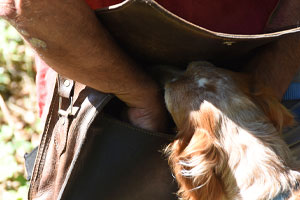
His family’s traditions are most evident in his methods, which set him apart from some of his competition, beginning with the breed of dog he uses. While many feel that a Labrador is the perfect fit, he uses mutts with great success. Though he won’t reveal his family secrets, he contends that sex or breed matter little; what matters is how they are trained and treated.
Despite all his caution, Christian is a generous host. He speaks freely about his business and is happy to demonstrate how to find a truffle and to showcase his dogs’ prowess. After a brief explanation of the industry and his family’s business, he takes one of his dogs out, carrying an old leather satchel containing treats for his hunters, a separate pouch for his prized discoveries, and a small hooked iron rod, sharpened to a point, for digging out his treasure.
But his openness has its limits because secrecy is essential in this trade. When your fortune lies hidden underground and sells for $315 to $550 a pound, the location of a productive truffière is a family treasure to be guarded.
However, being a trufficulteur also has its perils. Thieves work the plantations at night after rain; disputes over black diamond truffles have, at least once, ended in murder. Between theft, the discovery of secret methods, bad weather, and the many unknowns, replicating success in truffle farming has never been certain.
A trufficulteur will say he depends on God’s mercy, hard work, and a good deal of luck. In the end, a productive year yields a profit, but a bad year still sustains these farmers because demand always drives prices up during shortages. A trufficulteur doesn’t negotiate the price of his truffles; customers buy what he sells.
Two centuries after Talon planted his acorns, a map reveals the truffle’s genome and inoculated seedlings with laboratory precision—yet no grower can guarantee a harvest. That is why truffle farming remains nearly the same as it was in France 200 years ago. It is the fruit of Christian civilization, which relies on an act of faith in God’s goodness, and on secrets hidden underground, fiercely guarded by the hands of the families who pursue it.
Photo Credit: The American TFP Photo Archive