

The synodal process inaugurated by Pope Francis is working toward the complete transformation of the Catholic Church that the Argentine Pope desired: “In this Church, as in an inverted pyramid, the top is located beneath the base.”1 In other words, Pope Francis’s “Synodal Church” will be an egalitarian church.
But more than just Church structures—her visible and hierarchical society—will be shaken. Her very mission to save souls and to inform a Christian civilization will be turned upside down, and her doctrine and morals will be aligned with the fashions and evils of the world, contrary to what the Apostle says: “Be not conformed to this world” (Rom. 12:2).
On May 5, the General Secretariat of the Synod [of Bishops] released the final documents of Study Groups 7 (part 1 only) and 9 in preparation for a post-synodal meeting, the October 2028 Ecclesial Assembly.
These study groups are composed of cardinals, bishops, theologians, religious, and lay people.
Group 7’s discussions focused on making the system for appointing bishops more egalitarian, incorporating the participation of lay people. Group 9 addressed the Church’s paradigm shift and “the experience of homosexual persons who are believers.”2
We will review Study Group 9’s report, “Theological Criteria and Synod Methodologies for Shared Discernment of Emerging Doctrinal, Pastoral, and Ethical Issues” (hereafter the “Report”), because it most clearly presents the doctrine behind the fundamental change proposed to the Church’s theological and moral doctrines and disciplines.3
The Case Studies for the Study Group 9 Report Were Two Homosexual Activists
The document purports to examine the issue of individuals who experience same-sex attraction. However, it relies exclusively on the accounts of two homosexual men, each of whom is “married” to another man. They believe not only that sodomy is not a sin, but “a gift from God,” and argue for the legitimacy of same-sex “marriage” as a path to God.4
By selecting the life stories of two homosexuals who are proud of their sinful relationships rather than testimonies from individuals who, although experiencing same-sex attraction, strive to avoid sin, Study Group 9 made it clear that this choice influenced its conclusion. The Report aligns with the goals of the influential “Catholic” homosexual movement and criticizes the Catholic movement Courage, which aims to help people with same-sex attraction live a virtuous life (see 2.1,5).
It is unthinkable that these testimonies were published without any criticism or condemnation as case studies for what is stated in the Report’s doctrinal section.
This was the conclusion reached by Cardinal Willem Eijk, archbishop of Utrecht, in the Netherlands, in his reflections on the Report: “By elevating such testimonies without doctrinal commentary, the report effectively normalizes homosexual relationships within a Church context. This represents a clear attempt to weaken the proclamation of Catholic moral teaching.”5
The homosexual activists who served as models—the first Portuguese, and the second American, each “married” to another man—are both well-known to Fr. James Martin, S.J., the leading figure of the homosexual movement in the Church here in America.6
Culture as an Interpreter of Revelation
The theologians who drafted the Report wanted to justify homosexuality despite its clear condemnation by divine Revelation, the Church’s two-thousand-year-old Magisterium, and Natural Law written in the hearts of men (see Rom. 1; 2:14–15).
To achieve this goal, they adopted the same approach used by the modernists a hundred years ago (condemned by Saint Pius X), and their nouvelle théologie followers (condemned by Pius XII), namely, to make all human understanding dependent totally on culture and history, so that not only Divine Revelation but also natural knowledge constantly evolves with the cultural shifts.
Thus, the Report reads: “No one knows the universal directly, because it is always mediated in a historical-cultural manner…. The universal truth of the human, in its historical expression, cannot therefore be determined once and for all, but is found in the concrete forms of different cultures, in an unceasing dialogue in which cultures and people are formed through the exchange of gifts with one another, driven by the search for truth and justice in the light of the Gospel” (I-1.2, p. 11).
Given the ongoing change in the understanding of truth, including the understanding of human nature, one could argue that, today, homosexual acts are no longer against nature. This is what the Report suggests:
“What is at stake, as is clearly understood, is the overcoming of the theoretical model that derives praxis from a ‘pre-packaged’ doctrine, ‘applying’ general and abstract principles to the concrete and personal situations of life” (III-2.3, p. 26).
This theory, a result of the old nominalist error7 and modern relativist philosophies, means you can no longer establish moral rules that apply to everyone.
Consequently, the moral law that originates from Divine Revelation and natural law, imprinted on our hearts and revealed through reason, is ignored or completely relativized. As is readily seen, this paves the way for relativizing the entirety of Revelation and the Church’s perennial moral teachings.
Therefore, the Report proposes a complete shift in the Church’s interpretation of Sacred Scripture as held in “past centuries” (I-1.1, p. 8).
“Paradigm Shift”
According to the Merriam-Webster Collegiate Dictionary, a paradigm shift is “an important change that happens when the usual way of thinking about or doing something is replaced by a new and different way.”8
The Report states that “practicing the synodal nature of the Church implies the implementation of a ‘paradigm shift’ (cf. VG 3) from the prevailing paradigms of past centuries regarding the way of interpreting and expressing the proclamation of the Gospel and the mission of the Church” (I-1.1, p. 8).
Once implemented, this “paradigm shift” would mean the destruction of the entirety of the Church’s dogma and morality. Were such a change possible, it would spell the end of the Church herself, as it would involve altering her doctrine and pastoral care, indeed her very mission, to adapt to today’s atheistic and immoral culture. Can anyone truly claim that the aberrations being proposed to the faithful are still the perennial teachings of the Church on faith and morals?
Touching on this most delicate point, Cardinal Gerhard Müller observes:
They [the Study Group findings] are fatally similar in two respects: 1. Through their distrust of the central tenets of Catholic doctrine,…and 2. in their attempt to align themselves with prevailing ideologies through a so-called “paradigm shift from rigid dogmatism to a people-friendly pastoral approach” in order to gain recognition from their proponents.
They do not openly deny the revealed truths. But they ignore them and build their own house of a comfortable and worldly-conforming Christianity alongside them…. The private or even paraliturgical blessing of same-sex and opposite-sex couples in irregular relationships is based on the heretical denial of the revealed truth that God created human beings as man and woman.”9
In his turn, Fr. Gerald Murray, a canon lawyer and pastor of St. Joseph’s Church in New York City (Yorkville neighborhood), comments: “To describe Catholic teaching using the analogy of a framework upon which theories and experiments are arranged is to demote it from the realm of truth into just one possible approach to presenting God’s revelation. Jesus said, ‘I am the Way, the Truth, and the Life.’ (John 14:6) Is that a paradigm needing improvement?”10
Does Homosexual Sin Lead to God?
The Report includes two appendices with the written testimony of the two homosexual activists. As Cardinal Eijk remarked, the Report publishes them without denouncing their errors.
In the account by Jason Steidl—the American activist whose photo appeared in The New York Times alongside his “husband” being blessed by Fr. James Martin, S.J., the day after the Vatican publication of Fiducia supplicans11—we read:
My sexuality isn’t a perversion, disorder, or cross; it’s a gift from God. I have a happy, healthy marriage and am flourishing as an openly gay Catholic…
…I thank God for my husband, whom I met five years ago. He’s been the greatest source of learning and grace in my life.12
This scandalous statement is presented to the faithful as aligning with the Church’s new paradigm.
Commenting on the other testimonial, from the Portuguese homosexual, the Report states that he discovered “that sin, at its root, does not consist in the (same-sex) couple relationship, but in a lack of faith in a God who desires our fulfillment” (III-2.1, p. 24).
This is the only mention of sin in the entire Report, and it is an attempt to deny the grave sinfulness of homosexual relationships, which the Church has always taught are intrinsically evil.
As St. Augustine states, every sin clearly involves a prior turning away from God and an attachment to creatures. However, as this Church Father and Doctor of the Church points out, sin is a violation of God’s Law: “Sin, then, is any transgression in deed, or word, or desire, of the eternal law.”13 In the case of the sodomitical relationship, there is a clear violation of this Law, which forbids sexual acts outside the lawful marriage of one man and one woman.
A Gnostic Heresy
The Report’s erotic mysticism views as good and even holy a sin that deserved the destruction of Sodom and Gomorrah (see Gen. 18:19.) Commenting on the accounts of the two homosexuals, “married” as they are to someone of the same sex, the Report states that in them “one can detect the emergence of ‘experiences of goodness’ in the form of successive stages of development in the individuals involved, alongside the establishment of good practices within Christian communities” (III-2.1, p. 24).
Tellingly, Bishop Athanasius Schneider correctly sees in the Report the false erotic mysticism of the Gnostic-Nicolaite heresy, which promoted immorality.14
This final report has unequivocally crossed the line from orthodoxy into heresy. The report employs the beguiling phrase “paradigm shift,” to undermine, with empty rhetoric, God’s Revelation about the binary nature of the sexes, and His clear prohibition of any sexual acts outside of a valid marriage between a man and a woman. Pope Leo XIV’s first duty is to protect the Church and the souls of the faithful from this brazen Gnostic doctrine, which seeks to justify fornication and unnatural vice. The voice of Christ, which rebuked the church in Pergamum for tolerating the sexual heresy of the Nicolaitans (cf. Rev. 2:14–15) and accused the church in Thyatira of permitting Jezebel—who “called herself a Prophetess”—to spread sexual immorality in the Church (Rev. 2:20–21), is also addressed to Pope Leo XIV today.15
In addition, Bishop Joseph E. Strickland warns:
The recent report issued by Study Group 9 of the Synod on Synodality is deeply alarming and stands in direct contradiction to the constant teaching of the Catholic Church regarding human sexuality, sin, marriage, and the moral law.
The Church cannot change what God Himself has revealed.16
The Authors of the Report
Vatican expert Gaetano Masciullo points out that:
To understand the nature of this report, however, one must look at the members chosen by Pope Francis in 2024 for Study Group 9, dedicated to the “theological criteria and synodal methodologies for the shared discernment of emerging doctrinal, pastoral, and ethical issues.”
Among the members, two figures in particular stand out, both active for years in the attempt to normalize homosexuality and other moral issues at odds with traditional Catholic doctrine: Cardinal Carlos Gustavo Castillo Mattasoglio, archbishop of Lima, and Father Maurizio Chiodi, member of the Pontifical Academy for Life.
Speaking of Cardinal Castillo Mattasoglio, he writes that in “a 2021 pre-Christmas homily…he stated that Christ ‘died as a layman,’ denying the priestly character of Christ’s sacrifice;…. These [heterodox] positions have favored his rise. An avowed defender of liberation theology, Mattasoglio has made LGBT propaganda one of his principal causes.”17
As for Fr. Maurizio Chiodi, in a 2019 interview to Noi famiglia & vita, the family supplement of Avvenire, the newspaper of the Italian Bishops Conference, he stated, “I would not rule out that, under certain conditions, a homosexual couple relationship may be, for that individual, the most fruitful way to live good relationships, taking into account their symbolic meaning, which is at the same time personal, relational, and social.”18
“How the Gold Has Lost Its Luster”
In these tragic times for the Church of Christ, Jeremias’s lament comes to mind: “Quomodo obscuratum est aurum.” “How the gold has lost its luster” (Lam. 4:1).
Why do people abandon the clear and beautiful doctrine and morality revealed by God, radiant as gold, to pursue “doctrines of devils” (1 Tim. 4:1)?
Providence permits this long and dark process as a punishment for our sins and, at the same time, as an opportunity for the righteous to prove their zeal for the faith (see 1 Cor. 10:13; 1 Cor. 11:19).
Most of today’s errors are the fruit of the modernist heresy, which, as mentioned, was condemned by St. Pius X, and of its nouvelle théologie reincarnation, which was condemned by Pius XII.
In 1907, St. Pius X wrote:
Blind that they are, and leaders of the blind, inflated with a boastful science, they have reached that pitch of folly where they pervert the eternal concept of truth and the true nature of the religious sentiment; with that new system of theirs they are seen to be under the sway of a blind and unchecked passion for novelty, thinking not at all of finding some solid foundation of truth, but despising the holy and apostolic traditions, they embrace other vain, futile, uncertain doctrines, condemned by the Church, on which, in the height of their vanity, they think they can rest and maintain truth itself.19
In 1950, Pius XII warned regarding the errors of the nouvelle théologie:
- Such fictitious tenets of evolution which repudiate all that is absolute, firm and immutable, have paved the way for the new erroneous philosophy which, rivaling idealism, immanentism and pragmatism, has assumed the name of existentialism, since it concerns itself only with existence of individual things and neglects all consideration of their immutable essences.
- There is also a certain historicism, which attributing value only to the events of man’s life, overthrows the foundation of all truth and absolute law, both on the level of philosophical speculations and especially to Christian dogmas.20
“Be on Your Guard, Stand Firm in the Faith, Be Courageous, Be Strong”
However, trusting in the grace of God, which never fails those who are faithful, we must “stand firm in the faith” (1 Cor. 16:13), as the Apostle recommends.
At Fatima, Our Lady warned us of the severe punishment that would come if men did not stop sinning, not just out of weakness, but because they made sin their pride and reason for living.
However, she added, “Finally, my Immaculate Heart will triumph.” In the certainty of the Most Blessed Virgin Mary’s triumph, we find the courage to fight on despite today’s egregious errors.
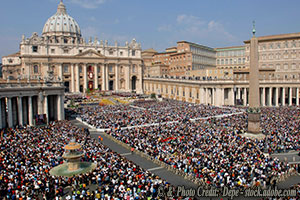
Photo Credit: © Depe – stock.adobe.com
First published on TFP.org.
Footnotes
- Francis, “Address of His Holiness Pope Francis,” Ceremony Commemorating the 50th Anniversary of the Institution of the Synod of Bishops (Oct. 17, 2015), https://www.vatican.va/content/francesco/en/speeches/2015/october/documents/papa-francesco_20151017_50-anniversario-sinodo.html. (In quotes, any emphasis in the original is shown in italics. My emphases are shown in bold.)
- General Secretariat of the Synod, “The Selection of Bishops and the Handling of Emerging Doctrinal, Pastoral, and Ethical Questions,” Synod.va, May 5, 2026, https://www.synod.va/en/news/the-selection-of-bishops-and-the-handling-of-emerging-doctrinal.html.
- See Study Group 9, “Theological Criteria and Synodal Methodologies for Shared Discernment of Emerging Doctrinal, Pastoral, and Ethical Emerging issues,” Synod.va, accessed May 17, 2026, https://www.synod.va/content/dam/synod/process/implementation/10workinggroups/final-reports/sg9/SG-9_Final-Report.pdf. See also, the Report’s three-page “Executive Summary,” Synod.va, accessed May 17, 2026, https://www.synod.va/content/dam/synod/process/implementation/10workinggroups/final-reports/sg9/SG-9_ENG_Executive-Summary.pdf.
- See Appendix A.1 “Testimony for Synodal Study Group 9 on Homosexuality (Portugal),” Synod.va, https://www.synod.va/content/dam/synod/process/implementation/10workinggroups/final-reports/sg9/Testimony-A1-Homosexuality.pdf; Appendix A.2 “Testimony for Synodal Study Group 9 on Homosexuality (USA),” Synod.va, https://www.synod.va/content/dam/synod/process/implementation/10workinggroups/final-reports/sg9/Testimony-A2-Homosexuality.pdf.
- Cardinal Eijk, “Same-Sex Synod Report Must Be Forcefully Refuted,” National Catholic Register, May 14, 2026, https://www.ncregister.com/commentaries/the-synods-dangerous-departure-study-group-9s-report.
- See Diane Montagna, “Fr. James Martin: The ‘Mastermind’ Behind the Two Testimonies in the Vatican’s Synod Report on Homosexuality,” Diane Montagna’s Substack, May 14, 2026, https://dianemontagna.substack.com/p/fr-james-martin-the-mastermind-behind. See also James Martin, S.J., “How Same-Sex Couples Have Blessed Me,” Outreach.faith, Jan. 3, 2024, https://outreach.faith/2024/01/father-james-martin-how-same-sex-couples-have-blessed-me/.
- Nominalism: “a theory that there are no universal essences in reality and that the mind can frame no single concept or image corresponding to any universal or general term.” Merriam-Webster’s Collegiate Dictionary, s.v. “nominalism,” accessed May 18, 2026, https://unabridged.merriam-webster.com/collegiate/nominalism.
- Merriam-Webster’s Collegiate Dictionary, s.v. “paradigm shift,” accessed May 17, 2026, https://unabridged.merriam-webster.com/collegiate/paradigm%20shift.
- Cardinal Gerhard Müller, “On God’s Blessing and the False Blessings of This World,” in Michael Haynes, “Cardinal Müller: Synod’s Homosexuality Report Leads to ‘Heretical Relativization’ of Marriage,” PerMariam.com, May 8, 2026,https://www.permariam.com/p/cardinal-muller-synods-homosexuality.
- Gerald E. Murray, “‘Synodal Shepherds’ Attack the Sheep,” TheCatholicThing.org, May 9, 2026, https://www.thecatholicthing.org/2026/05/09/synodal-shepherds-attack-the-sheep/.
- See Amy Harmon, Ruth Graham, and Sarah Maslin Nir, “Making History on a Tuesday Morning, With the Church’s Blessing,” The New York Times, Dec. 19, 2023, https://www.nytimes.com/2023/12/19/us/catholic-gay-blessing-pope-francis.html.
- Appendix A.2.
- St. Augustine, Contra Faustum, book XXII, no. 27, https://www.newadvent.org/fathers/140622.htm.
- Nicolaitism: “Traces of the aforementioned sexual licentiousness (Rev. 2:2) are found, but now combined with mythological speculations (‘the abysses of Satan,’ Rev. 2:24), which are generally interpreted as an allusion to Gnostic conceptions.” H. Haas, A. van den Born, and S. de Ausejo, Diccionario de la Biblia (Barcelona: Herder, 1967), 766.
- Diane Montagna, “Bishop Schneider: Vatican’s Synod Report on Homosexuality Echoes ‘the Serpent in the Garden,’” DianeMontagna.substack.com, May 12, 2026, https://dianemontagna.substack.com/p/bishop-schneider-vaticans-synod-report.
- Joseph E. Strickland, “An Emergency in the Church,” PillarsofFaith.net, May 5, 2026, https://pillarsoffaith.net/an-emergency-in-the-church/.
- Gaetano Masciullo, “Meet the Architects of the Synod’s Challenge to Church Teaching on Homosexuality,” LifeSiteNews.com, May 14, 2026, https://www.lifesitenews.com/news/meet-the-architects-of-the-synods-challenge-to-church-teaching-on-homosexuality/.
- Innocenzo, “Il teologo Maurizio Chiodi: ‘Omosessuali. Una pastorale oltre la retorica delle aperture,” Gionata.org, Jul. 28, 2019, https://www.gionata.org/il-teologo-maurizio-chiodi-omosessuali-una-pastorale-oltre-la-retorica-delle-aperture/.
- St. Pius X, encyclical Pascendi Dominici gregis (Sept. 8, 1907), no. 13, https://www.vatican.va/content/pius-x/en/encyclicals/documents/hf_p-x_enc_19070908_pascendi-dominici-gregis.html.
- Pius XII, encyclical Humani generis (Aug. 12, 1950), nos. 6–7, https://www.vatican.va/content/pius-xii/en/encyclicals/documents/hf_p-xii_enc_12081950_humani-generis.html.