


This article is the ninth part of a series about Purgatory, a topic that is rarely discussed today. A knowledge of Purgatory is essential if souls are to avoid the pains of this place of expiation. The prior article can be found here.
* * *
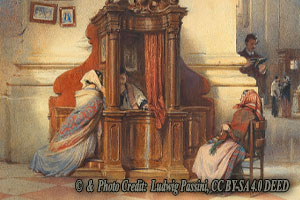
When going to confession, the tendency is to make a mental list of sinful actions and ask the priest to grant absolution for them. Unfortunately, few make room for sins of omission—the actions that people should have accomplished, but were forgotten, never completed or explained away in a bit of human justification.
Unlike sins of commission—evil acts committed deliberately—which require effort, sins of omission are amazingly easy to commit. Returning from a scheduled break at work ten minutes late, conveniently “forgetting” a holy day of obligation, and so on, takes no effort and little thought. The excuses leap to mind—“everybody does it,” “I had a bad day,” “I deserve a break,” or “We were on vacation,” among many others. It is so easy to devise such self-justifications that many people quickly dismiss them from consciousness.
Yet, sins of omission are every bit as real as sins of commission, and these sins significantly increase the time that souls spend in Purgatory.
A Soul in Purgatory Appears
In his book, Purgatory, Father F. X. Schouppe gives many examples of virtuous people who are in that state because of those acts they ought to have done, but did not do. In Chapter eighteen, Father Schouppe mentions Brother John de Via, “a holy religious,” who was a member of the Order of the Friars Minor—commonly known as the Franciscans.
Brother John was working in a Franciscan house in the Canary Islands when he was struck with illness and confined to the infirmary, where he died.
After Brother John’s death, the infirmarian, Brother Ascension, was praying for the soul of the departed. Suddenly, a beautiful light flooded Brother Ascension’s cell. In the light, the good brother saw a human figure, but he was unable to recognize him. Astonished, he collected his wits and asked the figure who he was and why he had appeared in his cell.
A Request
“‘I am,’ answered the apparition, ‘the spirit of Brother John de Via. I thank you for the prayers which you have poured forth to Heaven in my behalf, and I come to ask of you one more act of charity. Know that, thanks to the Divine mercy, I am in the place of salvation, among those predestined for Heaven—the light which surrounds me is a proof of this. Yet I am not worthy to see the face of God on account of an omission which remains to be expiated. During my mortal life I omitted, through my own fault, and that several times, to recite the Office for the Dead, when it was prescribed by the Rule. I beseech you, my dear brother, for the love you bear Jesus Christ, to say those offices in such a manner that my debt may be paid, and I may go to enjoy the vision of my God.’”1
Astonished, Brother Ascension raced to his superior. He described the visitation. Quickly, the brothers said the offices that John de Via had omitted.
The Easiest Sins
When other monks said the required offices, Brother John again appeared to Brother Ascension. This time, the light that surrounded him was more brilliant than on his previous visit, a dramatic sign that Brother John was then “in possession of eternal happiness.”
How easy it must have been for Brother John de Via to commit the sins that kept him out of Heaven! Perhaps he was in a hurry because he needed to complete some important task. Maybe he had worked hard that day and omitted the Office of the Dead because of understandable fatigue. Perhaps he was bored by saying the same prayers repeatedly and carelessly “skipped over” those passages in his prayer book without any real sense that he had done anything wrong. It is altogether possible that he had forgotten all about these omissions until he arrived to find Heaven’s doors temporarily closed to him.
Since Father Schouppe referred to John de Via as “a holy religious,” such omissions were likely quite rare. Other than that, readers have no other information about the state of Brother John’s mind or his general demeanor. However, many in the modern world would tend to look on such minor sins of omission as exceedingly minor, certainly not the sort of thing that would keep anyone out of Heaven.
Praying for Forgiveness From Long-forgotten Sins
God allowed Brother John to appear to Brother Ascension because his sins were so slight in comparison with Brother John’s otherwise rigorous and obedient life. Indeed, the occasion is noteworthy in part because it is so rare. It would be folly for people, no matter the extent of their piety, to assume that Our Lord will extend the same opportunity to them.
Therefore, it makes sense to ask God to bring to mind any sins of omission that as part of preparation for the Sacrament of Confession. Another would be to add the Confiteor to one’s daily prayers while contemplating sins of omission:
I confess to Almighty God, to Blessed Mary ever Virgin, to Blessed Michael the Archangel, to Blessed John the Baptist, to the Holy Apostles Peter and Paul, to all the angels and Saints, and to you, brethren, that I have sinned exceedingly in thought, word and deed: through my fault, through my fault, through my most grievous fault. Therefore I beseech the Blessed Mary ever Virgin, Blessed Michael the Archangel, Blessed John the Baptist, the Holy Apostles Peter and Paul, all the Saints, and you, brethren, to pray for me to the Lord our God.
To read the next article in this series, please click here.
Photo Credit: Ludwig Passini
First published on TFP.org.
Footnotes
- All quotations in this article (unless another source is mentioned) use the 1905 version of Father F. X. Schouppe’s Purgatory, published in Great Britain by Burns, Oates and Washbourne, Ltd. It is in the public domain and available through the Internet Archive. The spellings of certain words may have been Americanized by the author.