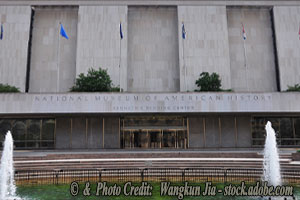
The Smithsonian’s American History Museum Substitutes Radical Theories for Historical Facts
“The mission of the National Museum of American History is to empower people to create a just and compassionate future by exploring, preserving, and sharing the complexity of our past.”
Mission statements like the above are supposed to encapsulate an organization’s most important goals. Hours go into the process; extreme care is exercised behind each word and phrase. So, it is fair to ask what the Smithsonian’s National Museum of American History (NMAH) means by saying it wants to “create a just and compassionate future” through “sharing the complexity of our past.” Such phrases may sound harmless, but they can also reflect a radical interpretation of the nation’s history.
Saving America’s Story
That is the primary criticism described in Saving America’s Story: How Ideological Capture at the Smithsonian Museum of American History Erases Our Heritage, a 160-page review of the Smithsonian Institution drafted by the Domestic Policy Council (DPC). The report argues that the museum “no longer treats the American story as a shared national inheritance to be taught or celebrated but as a political instrument to divide, dispirit and discourage our citizens.”
The report presents two main arguments. First, the NMAH “refuses to tell America’s core story,” a single narrative that starts with Francisco Vázquez de Coronado’s 1540-1542 exploration of the southwestern United States to modern times. Telling such a story is crucial. No one can understand the details of history without a basic knowledge of a nation’s story from beginning to end.
Second, “the NMAH relentlessly presents political activism as a substitute for its main purpose.” In other words, it artificially inflates those aspects of U.S. history that lead visitors to embrace the leftist emphasis on oppression, class struggle, power and race as the prime movers of history.
A History of Radicalism
The NMAH is part of the Smithsonian museum network and occupies a special place among American history museums. Its location on Washington, D.C. ’s National Mall gives it prominence alongside the Capitol, the White House and the city’s many monuments. Such prominence conveys the sense of an official government presentation of the nation’s past.
Unfortunately, NMAH compiles a very radical and dystopian conception of history, using selected events to deliberately portray the nation at its most deplorable.
The current attitude has grown like a diseased plant over the decades. It first came to light in 1995, when NMAH prepared an exhibit in honor of the fiftieth anniversary of the end of World War II. Its focus was the dropping of an atomic bomb on Hiroshima. The resulting display appalled millions of Americans, including World War II veterans. Rather than emphasizing the vast number of American lives saved and the defeat of fascism, much of the signage presented the event as the heinous act of a power-mad American government. Overwhelmed by the criticism, the museum relented, making the exhibit far more neutral.
Unlearned Lessons
One of the legions who did not learn the lessons of that debacle was Anthea Hartig, who has directed the NMAH and its 257 employees since 2019. Under her leadership, the museum redoubled its efforts to present radical views of the nation’s past.
An excellent illustration of Dr. Hartig’s inclinations is a 2020 film she prepared in conjunction with the History Channel. “My Favorite Things” was presented during a talk she gave as part of the University of California, Riverside’s “Chancellor’s Distinguished Lecture Series.” It is her personal tour through the NMAH collection. She singled out fifteen items. In order of appearance, they were:
A 1701 Stradivarius cello
A cane that belonged to Haitian revolutionary dictator Toussaint L’Ouverture
A watch made to tell time in the dark, owned by Helen Keller, who became a socialist at the end of her life,
A 1920-era surfboard designed by Hawaiian native Duke Kahanamoku
A baseball and glove used at the Gila River Japanese Internment Camp during World War II
A 48-star U.S. flag carried by Lt. Howard van der Beek during the D-Day landing
A scrapbook assembled by minor league baseball player Leopoldo Martinez during the forties.
Shoes used by Althea Thomas to play the organ in Martin Luther King’s Dexter Avenue Baptist Church during the Montgomery bus boycott of 1955-1956.
The dress that the feminist and lesbian tennis player, Billie Jean King, wore when she defeated Bobbie Riggs in 1973.
Declaration scroll written by novelist Maya Angelou for the National Women’s Conference.
Homemade Superman cape worn by Matthew Shepard as a child. Mr. Shepard was beaten to death in 1998, purportedly because he was homosexual.
A papier-mâché depiction of the Statue of Liberty carried by a crowd of primarily Mexican, Haitian and Guatemalan agricultural workers in a 234-mile protest march
A modern tin-type photo of a “tribal elder.”
The costume worn by actress Elizabeth Moss in The Handmaid’s Tale.
Homemade butterfly wings worn by a pro-immigration activist in a 2018 protest march.
Intersectionalist Relics
A common thread ties most of these items. All except the cello and the flag connect to some aspect of the intersectional and class struggle narrative.1 that is so dear to leftists.
The real significance of Dr. Hartig’s list lies in the items it omits. There is no representation of religion, other than the reference to Dr. King. Nothing points to any significant positive action by a president or Congress. No item indicates a technological, material or medical improvement in people’s lives. There are no items other than the flag commemorating a war, the lives of those who defended the country or anything that could inspire thankfulness for being part of this great nation. Thirteen of the fifteen items relate to some form of intersectional tribalism and its associated disgrace.
Dr. Hartig’s “favorite things” list illustrates the criticisms found in Saving America’s Story. In fairness, a twenty-minute video can not adequately present the contents of the entire museum. However, using it as a microcosm of her priority list seems perfectly fair.
The NMAH reaction has been to defend its selections. The Smithsonian’s Chief Marketing Officer, Julissa Marenco, told a compliant The New York Times, “For more than 180 years, the Smithsonian has served the American public with nonpartisan and independent scholarship, and we remain committed to doing so.”
Inaccurate, Unobjective and Imbalanced
However, National Review correctly summarizes the report’s tone and thrust. “From Saving America’s Story, we learn how ideologically partisan activism metastasizes under a veneer of bipartisanship. We see how slick and condescending elites selectively disclose and disguise their true intentions. And we discover just how crazy-radical these educated elites truly are. This is a fight whose importance goes well beyond the case in question. The battle over the Smithsonian is a prototype of the wider cultural clash we’re facing — and will continue to face into the indefinite future.”
Any history teacher dedicated to teaching the truth will acknowledge that there is never enough time to tell the whole story. Any museum, even the largest, faces similar limits. Choices are inevitable. However, the spirit behind those choices is crucial. The key guidelines determinants should be accuracy, objectivity and balance. Dr. Hartig’s NMAH violates them all.
Intersectionality is a framework that explains how a person’s overlapping social identities (such as race, gender, class, sexuality, and ability) combine to create unique forms of discrimination or privilege. Class struggle claims that history is a constant fight between the oppressed and the oppressors.