

Even the most hardened liberals have to admit something is wrong with the liberal order that has long dominated modernity. The social and cultural structures upon which this order is built have broken down—notably the family, community, and church. As the reigning political philosophy, liberalism must take at least some blame for the present social decadence.
Thus, a debate rages over liberalism’s future. Classical liberals double down and insist the model is working. It is only a matter of tweaking the system or putting in check the “woke” liberals who really aren’t liberals in the first place.
Labeling the Postliberals
Meanwhile, those who have in any way opposed liberalism since the French Revolution (or even before) are lumped together as “postliberals.” This diverse universe encompasses ultramontanes, nineteenth-century saints, popes and scholars, medieval figures, Action Française members, nationalists, Franco followers, national conservatives, Christian nationalists, populists and Catholic integralists.
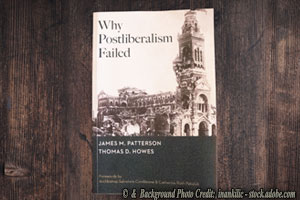
This haphazard grouping of people is the target of the book, Why Postliberalism Failed. The work tries to frame the debate and discredit the postliberal challenge to the liberal order. Authors James Patterson and Thomas Howes construct a vast and complex web of conspiracy, consisting of past and present figures who attack the liberal order. They especially concentrate on Catholic postliberalism.
Rather than trying to untangle the authors’ peculiar historical perspectives, suffice it to say the book has three great disappointments.
Who Made Postliberalism Fail
The first disappointment involves its failure to recognize the gravity of the present crisis and address the legitimacy of questioning certain liberal principles
The book is an obvious rebuttal to Patrick Deneen’s Why Liberalism Failed. That book pointed to the corrosive effect of liberal principles that undermine liberalism’s foundations. He showed how liberalism’s excessive individualism atomizes people, its secular outlook exiles God from the public square, and its globalism can erode cultural identity. These are rather traditional complaints against liberalism in particular and modernity in general that are open to debate.
Why Postliberalism Failed does not address these complaints; instead, it focuses on some of the figures who oppose the modern order. It attacks these often-bizarre messengers, not the message of what ails modernity. The authors then turn these strange figures into spokesmen for all who question the liberal order.
Conspiracy Theories
The second disappointment concerns the book’s lack of historical perspective, especially regarding the nineteenth century.
The authors suffer from an obsession with conspiracy theories. For example, they label as postliberal those who were pre-liberal. Thus, Boniface VIII (1235-1303!) is said to be part of a postliberal movement.
They further present all those who opposed liberalism (including popes) as figures who reduce their fight to blaming a Judeo-Masonic conspiracy for all the century’s woes. They explain that “reactionary thinkers hoped to explain away very real problems with the ancien regime [of pre-revolutionary France] by way of the Judeo-Masonic conspiracy.”
In denouncing one conspiracy theory, the authors construct another, since any passing reference to an ultramontane figure is enough to entangle a person in this web of intrigue against liberalism. Any legitimate effort to oppose attacks against the Church’s rights is mixed with this conspiracy.
A Century of Fighting for Catholic Rights
The political dramas of the nineteenth century cannot be reduced to such terms. Catholics had to fight for the Church’s rights. An intense effort across religion, culture, politics and society was underway during this time that the book’s narrative does not tell. It involved popes, elites, statesmen, theologians, saints, members of the French Academy and philosophers.
For example, there were ultramontane figures like Daniel O’Connell and Cardinal Henry Edward Manning who lifted Catholics in Ireland and England out of their ghettoized existence in the Protestant British Isles. There is little acknowledgment of brutal and anti-clerical attacks upon Church properties, the unjust confiscation of the Papal States and the suppression of ecclesiastical institutions, all of which demanded and received a response.
In addition, the authors treat the impressive works of nineteenth-century popes against liberalism and freemasonry as mere political documents, rather than as part of the ordinary Magisterium of the Church that the faithful are called upon to accept with religious assent.
Leo XIII, for example, wrote the encyclical Humanum genus against freemasonry and Libertas against liberalism, warning of very real dangers, not imagined plots. These cannot be casually disregarded. And yet they are. In their place are cherry-picked Vatican II documents, which the authors present as the only ones worth following.
The theme of Judaism was present on both the left and the right during this period, when Marx, Proudhon and even G. K. Chesterton were accused of anti-Semitism. Anti-Jewish tropes and stereotypes were everywhere. If this is to be the criterion to judge figures of that time, very few would survive unscathed. To reduce all those fighting for the rights of the Church to Judeo-Masonic conspiracy theorists is indeed disappointing.
Class Struggle Narratives
Even more disappointing is that this conspiracy is inserted into a class-struggle framework that has always distorted historical facts.
Thus, the Protestant Revolution is framed as a revolt against a sadly decadent Church hierarchy, and not an expression of a horrible heresy. The French Revolution is seen as a spontaneous clash between classes, not as an egalitarian revolt against authority and hierarchy that the authors admit unleashed a terrible persecution against the Church and Christian civilization.
This viewpoint turns history into a clash of self-interests rather than principles. Indeed, the authors explain that the Church condemned post-French Revolutionary, anti-clerical liberalism not because it was wrong, but because it was “a desperate effort by the Church to prevent another French Revolution and to protect herself from future abuse by temporal powers.”
No Spiritual Dimension
Such a perspective does not allow for a spiritual side to history. The nineteenth century was a time of renewed religious fervor after the terror of the French Revolution. It was full of new congregations and saints such as Saint John Bosco, Saint John Vianney, Blessed Pius IX, Saint Therese of Lisieux, Saint Peter Julian Eymard, and Saint Anthony Mary Claret.
These saints and others had an immense positive impact on this fight. A Counter-Revolution was underway, but these glorious contributions are neither present nor recorded in the book’s lopsided historical outlook. Nor is there treatment of the apparitions of the Blessed Mother in Lourdes and later at Fatima that had major anti-liberal implications.
The story of Christendom is that of its saints, martyrs and heroes. It is a tale of fervor and failure, conversion and conflict. It chronicles the Church’s triumph over the worst manifestations of fallen nature.
Secular perspectives exclude God from history and deny the effects of His grace that can work wonders and convert whole nations.
Integralist Regimes Are Not Ideal or Catholic
The final disappointment is that the authors present the twentieth-century postliberal models implemented in many countries as if they were the ideal solutions for Catholics and all those who question liberalism. At one point, they ask, “Must a Catholic consider an integralist regime ideal?”
Indeed, the authors convincingly prove that these twentieth-century postliberal models failed. They show that present postliberals who follow these same models will also fail. However, such proposals are neither ideal nor Catholic. Those who address the present crisis must reject them.
No More Godless Crusades
More often than not, the leaders of these cited movements were atheists like France’s Charles Maurras, opportunists like Brazil’s Plinio Salgado, charismatic dictators like Benito Mussolini or strong men like Argentina’s Juan Perón. These leaders saw the Church as a useful instrument for advancing their agenda.
None of them wanted a true Catholic program like that inspired by Saint Pius X’s call “to restore all things in Christ.” None presented a truly Catholic government like Garcia Moreno of Ecuador.
In addition, present postliberal movements are full of those who propose what European writer Tobias Cremer calls “godless crusades,” rich in Christian imagery but devoid of faith. One can find atheists, pagans and “cultural Christians” inside their ranks, many of whom live immoral lives.
What the authors prove is that non-Catholic systems cannot deliver Catholic results. They will always fail.
Such regimes are not the stuff from which a true Catholic revival will come. Likewise, the solution is not, as the authors insinuate, more liberalism.
The solution does not lie in liberalism or postliberalism. It is not found in complicated models or rigid ideologies.
What is needed are the movements of God’s grace, like those that converted the Roman Empire and barbarian peoples, and later gave rise to the organic Christian society found in Christendom. What is missing are saints who can inspire and motivate people to love God and practice virtue. From these conversions, everything else will come. Indeed, the words of Our Lord give the formula: “Seek ye therefore first the kingdom of God, and his justice, and all these things shall be added unto you (Matt. 6:33).”
First published on TFP.org.
Background Photo Credit: © inankilic– stock.adobe.com